
A Christmas Quarrel
For our final blog post of the year, we turn to a very special section of our archives, and bring to light a Christmas story brought to us directly from Ireland.
Our archives feature many different newspapers, some published in the states and others brought over through donations and immigration. One Dublin newspaper, The Irish Packet, was an enticing journal of stories and tales published from 1903 to 1910. An offprint of the Freeman’s Journal (1763-1924), the Packet was primarily concerned with the publication of Irish writers of fiction and fancy.
The Packet was owned and edited by politician Matthias McDonnell Bodkin (1850-1933). Aside from his political work, he was a noteworthy journalist and author, though his own writing was very rarely published in this journal.
Instead, Bodkin focused on sharing others’ voices. Not only through the writers he published, but in his “letters to the editor,” where he encouraged his readers to feel comfortable and open in conversation with him. This would often lean to a more humorous tone, creating an informal publishing environment that allowed a friendly and present audience. He additionally built on this audience by hosting competitions, often of the same tone.
In this blog post, we will focus instead on a work by one of his published authors. Jane Barlow (1856-1917) was an acclaimed Irish author frequently featured in Bodkin’s Packet. Her works were primarily concerned with tales of the Irish peasantry, especially in a post-Famine setting. Though her writing was focused on her Irish background, she was a scholar of the world, traveling and learning other European languages to expand her scope. With this noted brilliance, she became one of the first women a doctorate from Trinity College Dublin, shortly after they first began granting women degrees at all.
Though Barlow is known for many different tales, this author has been hard pressed to find mention of some of the pieces found in our archival collections. As we look forward and work to create more digital access, we share one story here that seemed particularly fitting to the season.
In this piece, Barlow unravels a tale of family feuds, mysterious fiddlers, and Christmas pilfering. Please enjoy. Transcription is as follows.
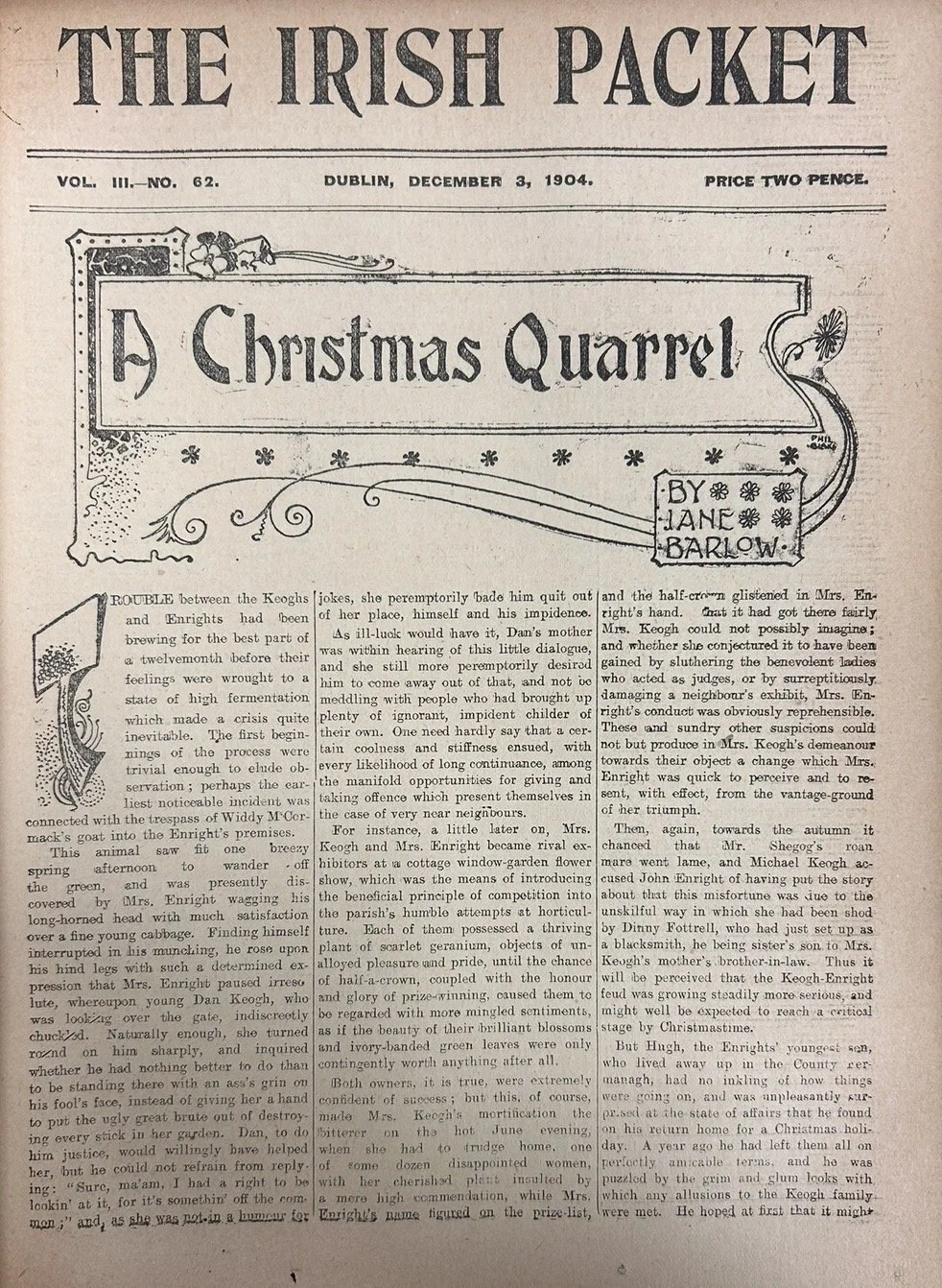
THE IRISH PACKET
VOL. III.--No. 62 Dublin, December 3, 1904 Price Two Pence
A Christmas Quarrel
By
Jane
Barlow
Trouble between the Keoghs
and Enrights had been
brewing for the best part of
a twelvemonth before their
feelings were wrought to a
state of high fermentation
which made a crisis quite inevitable. The first begin-
nings of the process were trivial enough to elude ob-
servation ; perhaps the ear-
liest noticeable incident was
connected with the trespass of Widdy M’Cor-
mack’s goat into the Enright’s premises.
This animal saw fit one breezy
spring afternoon to wander off
the green, and was presently dis-
covered by Mrs. Enright wagging his
long-horned head with much satisfaction
over a fine young cabbage. Finding himself
interrupted in his munching, he rose upon
his hind legs with such a determined ex-
pression that Mrs. Enright paused irreso
lute, whereupon young Dan Keogh, who
was looking over the gate, indiscreetly
chuckled. Naturally enough, she turned
round on him sharply, and inquired
whether he had nothing better to do than
to be standing there with an ass’s grin on
his fool’s face, instead of giving her a hand
to put the ugly great brute out of destroy-
ing every stick in her garden. Dan, to do
him justice, would willingly have helped
her, but he could not refrain from reply-
ing: “Sure, ma’am, I had a right to be
lookin’ at it, for it’s somethin’ off the com-
mon ;” and, as she was not in a humour for
[continuing parallel]
jokes, she peremptorily bade him quit out
of her place, himself and his [impidence].
As ill-luck would have it, Dan’s mother
was within hearing of this little dialogue,
and she still more peremptorily desired
him to come away out of that, and not be
meddling with people who had brought up
plenty of ignorant, impident childer of
their own. One need hardly say that a cer-
tain coolness and stiffness ensued, with
every likelihood of long continuance, among
the manifold opportunities for giving and
taking offence which present themselves in
the case of very near neighbours.
For instance, a little later on, Mrs.
Keogh and Mrs. Enright became rival ex-
hibitors at a cottage window-garden flower
show, which was the means of introducing
the beneficial principle of competition into
the parish’s humble attempts at horticul-
ture. Each of them possessed a thriving
plant of scarlet geranium, objects of un-
alloyed pleasure and pride, until the chance
of half-a-crown, coupled with the honour
and glory of prize-winning, caused them to
be regarded with more mingled sentiments,
as if the beauty of their brilliant blossoms
and ivory-banded green leaves were only
contingently worth anything after all.
Both owners, it is true, were extremely
confident of success ; but this, of course,
made Mrs. Keogh’s mortification the
bitterer on the hot June evening,
when she had to trudge home, one
of some dozen disappointed women,
with her cherished plant insulted by
a mere high commendation, while Mrs.
Enright’s name figured on the prize-list,
[continuing parallel]
and the half-crown glistened in Mrs. En-
right’s hand. That it had got there fairly
Mrs. Keogh could not possibly imagine;
and whether she conjectured it it have been
gained by sluthering the benevolent ladies
who acted as judges, or by surreptitiously
damaging a neighbour’s exhibit, Mrs. En-
right’s conduct was obviously reprehensible.
These and sundry other suspicious could
not but produce in Mrs. Keogh’s demeanour
towards their object a change which Mrs.
Enright was quick to perceive and to re-
sent, with effect, from the vantage-ground
of her triumph.
Then, again, towards the autumn it
chanced that Mr. Shegog’s roan
mare went lame, and Michael Keogh ac-
cused John Enright of having put the story
about that this misfortune was due to the
unskilful way in which she had been shod
by Dinny Fottrell, who had just set up as
a blacksmith, he being sister’s son to Mrs.
Keogh’s mother’s brother-in-law. Thus it
will be perceived that the Keogh-Enright
feud was growing steadily more serious, and
might well be expected to reach a critical
stage by Christmastime.
But Hugh, the Enrights’ youngest son,
who lived away up in the County Ter-
managh, had no inkling of how things
were going on, and was unpleasantly sur-
prised at the state of affairs that he found
on his return home for a Christmas holi-
day. A year ago he had left them all on
perfectly amicable terms, and he was
puzzled by the grim and glum looks with,
which any allusions to the Koegh family
were met. He hoped at first that it might
[NEW PAGE]
be only some passing huff; but his
parents’ voluble statement of grievances
soon showed him that such was not the
case. So he made up his mind to a
rather dull holiday, since, having no bre-
thren at home, he had counted much on
the companionship of the numerous young
Keoghs, his contemporaries and former
school-fellows. Another cloud lowered on
Hugh’s Christmas week in the feeble
health of his grandfather, who “couldn’t be
moidhered with the noise of” Hugh’s
favourite recreation, “fiddling,” from which
he was therefore debarred indoors.
Beneath the Keoghs’ roof, not many
perches away, Hugh Enright’s return was
regarded as likely to bring on an acuter
phase of the quarrel ; and it seemed to
have actually done so one morning when
Michael Keogh declared that “none of them
dirty Enrights” should be invited to the
Christmas party. The announcement was
received with mingled feelings. His wife
cordially assented, saying that indeed
she’d be long sorry to see any of the pack
darkening her door; and his sister, Julia
Byrne, remarked that she thought John
himself might have been “middling dacint
if he hadn’t took and married one of the
Colemans.”
But his sons and daughters heard the
announcement with some dismay, partly
from friendliness towards Hugh, partly
from more interested motives. The
Keogh’s Christmas party had long been
an important social event in the neigh-
bourhood, and for two or three years past
the dance music had been supplied by
Hugh Enright, who was considered a
great performer. Father M’Queen had
averred that he had heard nothing to beat
Hugh’s playing at the Munster Feis; and
it was rumoured that he had been offered
a place worth pounds and pounds a week
in some Belfast music-hall. People of a
carping turn added that Hugh spent a
power of time over his bowing and scrap-
ing, and made as much fuss over his fiddle
–and it a plain-looking one enough–as if
it was a living Christian; but nobody
could charge him with giving himself airs
about his accomplishment, or deny that
he was always as ready to play for the plea-
sure of some child, or poor old body, as to
show off before a more critically apprecia-
tive audience.
And now the loss of his services
threatened the Keogh’s entertainment
with nothing less than disaster. For,
though the parish did contain, in the
persons of Bill Tierney and Terry the
Trotter, two other musicians of far inferior
powers, neither of these was just then to
be had ; and a party without dancing
seemed to the young Keoghs very little
better than dancing without music.
The father thought differently.
He had always been a sedate
[continuing parallel]
sort of man, disposed “for other
than dancing measures,” and he now
said that when they had a good fire on
the hearth, and their plenty of whiskey
and tay, it was a queer thing if they
couldn’t contrive to divert themselves
asking riddles and telling stories without
cutting capers into the bargain. At all
events they’d have to try.
Their mother, while entirely ap-
proving of the Enrights’ exclusion,
retained a livelier recollection of
her youthful tastes, and sympathised
with Rose and Molly and Larry and Dan
in their disappointment. She opined that
himself had a right to hire a proper fiddler
over from Ballynavore, “the way the
childer might have their bit of fun, and
them Enrights needn’t be settin’ them-
selves up wid the notion they were
hinderin’ anybody of doin’ whatever they
had a mind to, and no thanks to them, or
the likes of them.” But himself only
hoped ironically that they’d all be getting
their healths until he was ould ape enough
to spend three or four half-crowns on
fetching a man over from the other end of
the country to play jigs for a couple of
hours ; and the question seemed to be
most unsatisfactorily settled.
At the last moment, however, fortune
did them a kindly turn. On the after-
noon of St. Stephen’s Day, only a few
hours before the party was to begin, there
appeared in the village a strange old
fiddler, whose playing delighted all his
hearers. Less prepossessing was his aspect,
as he limped along in a ragged great coat,
with a battered, broad-brimmed caubeen
surmounting a tangle of fuzzy grey locks,
and shading one black-patched eye. But
his musical gifts fully counterbalanced all
such defects, and his rendering of the
“Minstrel Boy” caused the best qualified
connoisseurs in Kildonagh to pronounce
Hugh Enright himself a fool to him on the
fiddle.
It was promptly ascertained that
his services for the evening could be secured
on strictly moderate terms, and the young
Keoghs rushed home rejoicing to report the
lucky chance. Their father at first de
murred. Was it to be having in a tramp
off the road, from goodness knows where,
that as like as not, would walk off with any-
thing he could lay hands on, if he didn’t
burn down the house on them, or do
murder on them all in their beds? Troth
and bedad, they might put that notion out
of their heads. But the young folk
pleaded desperately against the throwing
away of this providential opportunity, and
were backed up by their mother’s forecasts
of “them Enrights’” malicious glee over
the precluded dance.
So when Dan proceeded to urge
that if robbing and thieving was
what the poor man was up to, he
[continuing parallel]
wouldn’t be very apt to be sitting playing
away for next door to half an hour in the
police barracks, and went on to quote the
ponderous sergeant’s saying that the music
made him feel fit to dance a jig in heavy
marching order, old Keogh veiled his sur-
render in a jest, declaring that if Sergeant
Molloy was talking of dancing, they’d
better throw a few hundred-weight of stones
on top of their rick, for fear it might take a
fancy to be giving a few odd leps as well.
The Keogh’s party went off grandly, and
the stranger’s fiddling contributed largely
to its success. All agreed that no music
equal to its had ever been heard in the
parish, and Mrs. Keogh thought that if
Hugh Enright was there it might put him
out of conceit with his own scraping, he had
such an opinion of, while the master of the
house could not but allow that the fiddler
was “a quiet, dacint, ould crathur,” sitting
unobtrusively in a corner, with his hat
slouched to keep the light from his un-
lucky weak eyes, and refusing to emerge
even for refreshments. It would have
been a pity, after all, if the young gabies
had missed their bit of diversion, old
Keogh reflected, as he watched the bobbing
heads through a flickering glow.
Towards the end of breakfast next morn-
ing his family saw him suddenly look dis-
concerted, and begin to fumble rapidly
through all his pockets. Then he jumped
up, and examined his suit of best clothes,
hung behind the door, and finally he sped
out into the yard, where the car stood
under its shed, with his heavy great coat
lying on the top of the well. When the
others followed him, with shouted ques-
tions, to which he was flurry-deaf, they
found him diving into the depths of this
garment, “and he all of a tremble, and
crawkin’ to himself like a hin wid the
quinsey,” as his sister afterwards reported.
“It’s gone,” he said, “I’m ruinated–me
leather pouch–somebody’s took it on me.”
He had good cause to be dismayed, for
the pouch contained notes to the value of
over thirty pounds, which he had drawn out
of the bank the day before, driving into
Cornishtown on purpose, that he might buy
some young stock at the big Drumallin
Fair next week. The loss would mean the
destruction of the whole year’s farming
plans.
“I had it in a pocket of that,” he said,
“drivin’ home last night, and I actually
had me hand on it out here to bring it in-
doors wid me, when I was called away to
some fooling or the other, and it went clane
out of me head till just thi minyit. And
it’s took on me.”
Of course much agitated hunting and
ransacking followed, accompanied by many
conjectures and speculations. One of these
was offered by Julia Byrne. “Ne’ever a
wonder I’d wonder,” she said to her
brother, “if it was that ould strange fiddlin’
fellow. I’d no great opinion of lettin’ him
[NEW PAGE]
in here, and no more had you yourself,
Michael, at the beginnin’.” But he re-
quested her not to be talking foolish. “Sure
hadn’t I me hand on it the very minyit
before me comin’ into the house, and there
he was scrapin’ away in the corner, and
never stirred beyond it till I ped him his
two shillings, and let him out at the gate
meself, that I locked after him. Whoever
else it might be, I’ll take me oath it wasn’t
him.”
“I’ll tell you who it’s a dale liker to be,”
said Mrs. Keogh. “That young thief of the
world, Hugh Enright. I seen him slinkin’
about the yard gate not so very long before
you came home; and, what’s more, I was
torminted the whole evenin’ wid that ugly
little yella dog of his runnin’ in at the
door whenever it would be open. You
might remember, Larry, me biddin’ you put
it out a couple of times. And if that isn’t
a sign of Hugh himself bein’ somewheres
about the place, I dunno what else it was.”
“Begorrah, then, I mind now noticin’ it
meself,” said her husband, “and wonderin’
what brought it. To be sure it come after
that young miscreant. I’ll just step down
to the barracks and see what the sargint
has to say to it. And I’ll go before Mr.
Sullivan and get a summons agin these
Enrights, and a search-warrant–bedad will
I.”
“You’d do right to make all the haste
you can,” said Mrs. Keogh, “for you
couldn’t tell the instant he might slip off
out of this country, and then you might
whistle jigs for your money. His mother
has raison to be proud of him, herself and
her big lump of a geranium. Maybe it’s a
prize for pickpockets she might have a good
chance of gettin’ next time.”
“The mischief’s in it all, Molly,” Dan
Keogh whispered, drawing his sister aside.
“It ’ill be the death of ould Jimmy
Enright if they bring the polis landin’ into
the house wid any talk of takin’ up Hugh.
But you might as aisy stop the win’ blowin’
as himself there of stumpin’ off hotfut to
the barracks, and the divil knows where
else.”
Molly, in reply, whispered to him
more mysteriously, and at greater length.
“So run for your life,” she ended, and Dan
darted out of doors.
A few minutes afterwards, when Michael
Keogh had just got into his best clothes,
which he considered due to so grave an
occasion, and while everybody else was
scurrying about, and seeking and lament-
ing, who should come up the road,
with a hasty and intermittent hobble, but
last night’s old fiddler. He was followed,
at a discreet distance, by Dan and the
yellow terrier. Rose ran up to him, looking
panic-stricken, and began to warn him off
the premises ; but Molly pulled her back,
bidding her whisht for a stronsach, and at
the some moment their father bustled out.
[continuing parallel]
“Good day, me man,” he said, passing
on hastily. “But you needn’t be stoppin’
here. We want no music this morning’, and
be hanged to the whole of it.”
The fiddler was limping away, lamer than
ever, but Molly again interposed. “Whip
th’ ould caubeen off you,” she said. “Make
haste and slip out of the ould coat.”
“Is it diminted you are, Molly?” the
fiddler said, in a surprised undertone, “and
your father right forenint us?”
“Och, no matter for that, do as I bid
you, and quit play-actin’,” said Molly.
As the fiddler halted perplexed, Dan,
stepping behind him, snatched off the
slouched hat, and with it a fringe of
grizled grey hair, and a long beard.
“Whoo-oo–murdher; you had me choked
only for the string breakin’,” howled the
fiddler. “What are you at at all?”
“Me sowl to glory, and is it Hugh
Enright it is?” said Michael Keogh, arres-
ted by the spectacle in the midst of his
perturbation. “Whethen now, and who
was in it last night?”
“Sure you see ’twas just himself, father
honey,” said Molly. “The same that you
found fiddlin’ away in the corner when you
come in. A bit of a joke it was that we
made up among the whole of us.”
Her father’s unbiassed opinion of the
joke will now never be known, for before he
could express one, his son Larry came rush-
ing round the house-corner, waving aloft
some small object. “He’s got it,” all the
family exclaimed, with a general gasp of
relief.
“And where was it, Larry, avic, in the
name of goodness?” said Michael Keogh,
grasping the pouch with an eager hand, and
gloating over its familiar aspect, endeared
by an hour of dread.
“Well now, you might be lookin’ for it
long enough,” said Larry, “and it lyin’ in a
crack between the oat-bin and the wall.”
“Was it so?” said his father solemnly.
“Then I left it out of me hand when I went
to fetch the mare her feed, and it slipped
off wid the led opening’ and shuttin’.”
“Beded, it’s a lucky thing Larry had the
wit to be lookin’ there,” said Julia Byrne.
“Och, ’twas just a chance,” said Larry
modestly.
“All right they are, anyhow,” Michael
Keogh said, swiftly shuffling his notes,
while his quenched plans shot up again like
fire. In the glamour of them everything
looked praiseworthy, and he said– “Well,
Hugh, me lad, how’s yourself? ’Twas the
fine fools you made of us last night, but
the tunes were grand. We were all of us
sayin’ so this mornin’--weren’t we, Biddy?”
There was a rather awful pause, for
everybody felt that much must turn upon
what Mrs. Keogh would say.
She said–”Indeed we were so.
And what way is your poor
grandfather this mornin’, Hughey?
[continuing parallel]
We couldn’t be throublin’ your father and
mother to be comin’ out last night, knowin’
he was so poorly in himself; but I was just
about stepping’ over now to try would he by
any chance fancy a cup of beautiful thick
milk, or a drop of limonade?”
And in this reply everybody recognised
the preliminaries to peace.
JANE BARLOW.