
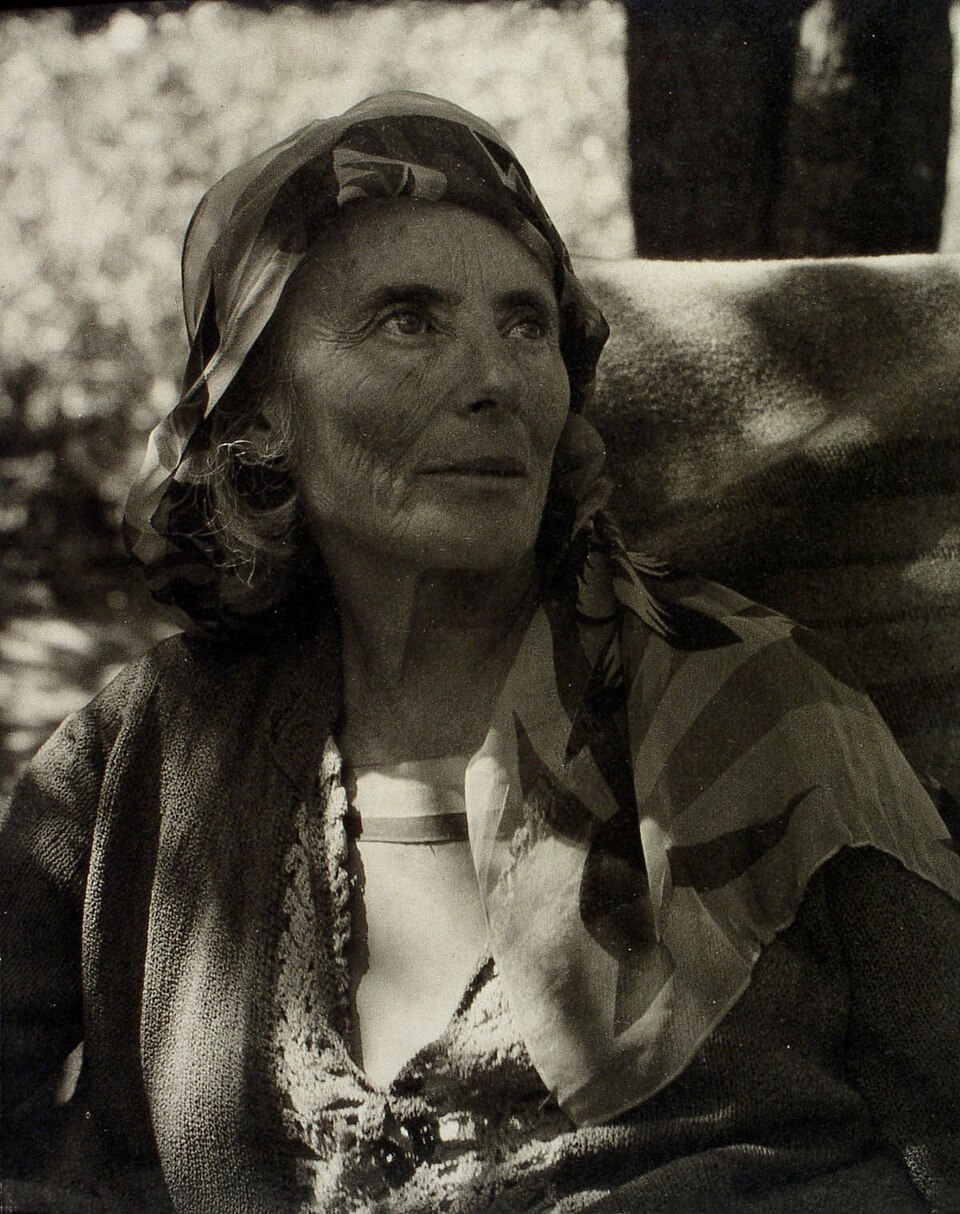
Photograph of Irish folklorist Ella Young circa 1 January 1942, unknown photographer
This week, we return to the mystical world of the Celtic Revival, looking now at the works of Ella Young. Young (1867-1956) was a poet, mythologist, and author of children’s literature. She was a writer who was active in the Gaelic and Celtic Revival, using the rising interest in Celtic mythology to inform her writing and teaching. Her works were hugely influential to writers both in Ireland and in the United States, uniting artists and writers in their shared mystical interests.
Young was born in Cullybackey, Co. Antrim to a Protestant family. She was the eldest of at least five daughters, with the records of her siblings being somewhat difficult to trace other than her sister Elizabeth, who became an actress. Her family moved south and when Young was thirteen, they settled in Dublin. Young studied at the Royal University of Ireland (RUI), where she graduated in 1898 with a BA in history, political economy, and law. She later received a master’s degree from Trinity College Dublin.
She was a lifelong learner, and her studious nature often brought her to the less examined parts of life. Young joined the Theosophical Society, where she met and befriended George Russell or AE (1867-1935), a figure we have examined previously. She improved her Irish language skills, and began digging deeper into the mystical origins of Irish folklore. On occasion, she would conduct research for others including Russell, who asked her to visit the Achill Island in 1902 and 1903 to research faeries for him by collecting folklore.
Like Russell, her interest in folklore went beyond an academic focus. Young believed in many aspects of Irish folklore, most notably faeries. She recounted these experiences, as well as descriptions of psychic abilities and astral projection, on numerous occasions. While her writing was largely retellings of Celtic folklore that had existed long before her time, it was impacted by these experiences and her descriptions often became more personal.
As was the case with many involved in the Revival, Young was a staunch proponent of Irish Nationalism, a supporter and close friend of Padraig Pearse, and a founding member of Cumann na mBan, the women’s auxiliary of the Irish Volunteer Army. Along with her dear friend Maud Gonne, Young smuggled supplies and weapons to the Republican forces. After the events of the Easter Rising of 1916, Young vocally opposed the Anglo-Irish Treaty and was detained by both the Free State in Mountjoy Jail and the North Dublin Union. Her friendship with Russell ended in this period due to their opposing views, and she spent the remainder of her time in Ireland working to commemorate the lost lives of the Rising.
Though the revolutionary part of her life was somewhat short-lived, she continued to express a tone of nationalism in her writing. In contrast to other Irish poets who were explicitly political, Young expressed her beliefs by prioritizing an archaized view of Ireland which saw the root of Irish nationalism within its myths and folklore.
In the 1920s, Young took these beliefs to the United States. On October 18th, 1925, The New York Times published an article entitled “Elfland Sends an Ambassador to the US,” announcing Young’s arrival to the states. In the article, the author describes her with effusive flattery, describing her incredible ability to not only translate the Irish, but bring the stories to their new readers with an excellent skill as a poet and storyteller herself. By the time this article had been printed, her writing was already well known across the globe. As the author states, “Children in the wild West of Ireland have recounted to her their dealings with eery playmates of the woods and fields; of spell-weaving lullables bringing slumber. Old men in fishing boats and huts have taught her incantations. Peasant women have whispered over a dying fire of peat about strange apparitions, disappearances, weird croonings in the wind, uncanny silences. Brides have confided to her their dreams” (NYT 6)[1].
In other words, her fame was already at a height and at fifty-eight, she was seen as an older woman by the standards of 1920s New York. This perceived age let her audience view her as a mysterious and mystical psychic woman, exotifying her for an American audience. This author describes her features as “the face of a poet and seer,” (NYT 8), making her very presence almost as powerful as her writing itself. The writers and artists of New York were enraptured by her instantly.
While the artistic crowd were eager to let her in, Young faced other issues when she got to the states. Essential to her persona was her belief in faeries. After all, her studies of folklore and the writing she produced around it were inconceivable without her personal experiences with fae-folk as she described them. Some might see these stories as metaphorical, while others (including Young herself) took them quite literally. When she arrived at Ellis Island, one immigration officer was concerned by these beliefs and decided to detain her, stating that a genuine belief in faeries deemed her mentally unfit for entrance. This resulted in a major press crisis, as her supporters appealed to the State Department and wrote numerous articles in her favor, pressing the importance of her intellect in the United States.
Once freed from detainment, Young moved past New York to the America she had sought out in the first place. Young came to the states to make her way to California, where she would become a lecturer at UC Berkeley.
Her lectures were immensely popular, though they came most often without any prior preparation. She stated that her lectures were “born between [herself] and [her] audience” (NYT 47). Yet, despite this, the lessons she shared brought her great admiration which has been kept in Berkeley still to this day. Dorothea McDowell, Young’s biographer, theorized that her success was in part due to her ability to accentuate her “ultra-Irish” persona for an American audience, reconciling her physical distance from the country by bringing its culture with her everywhere she went.
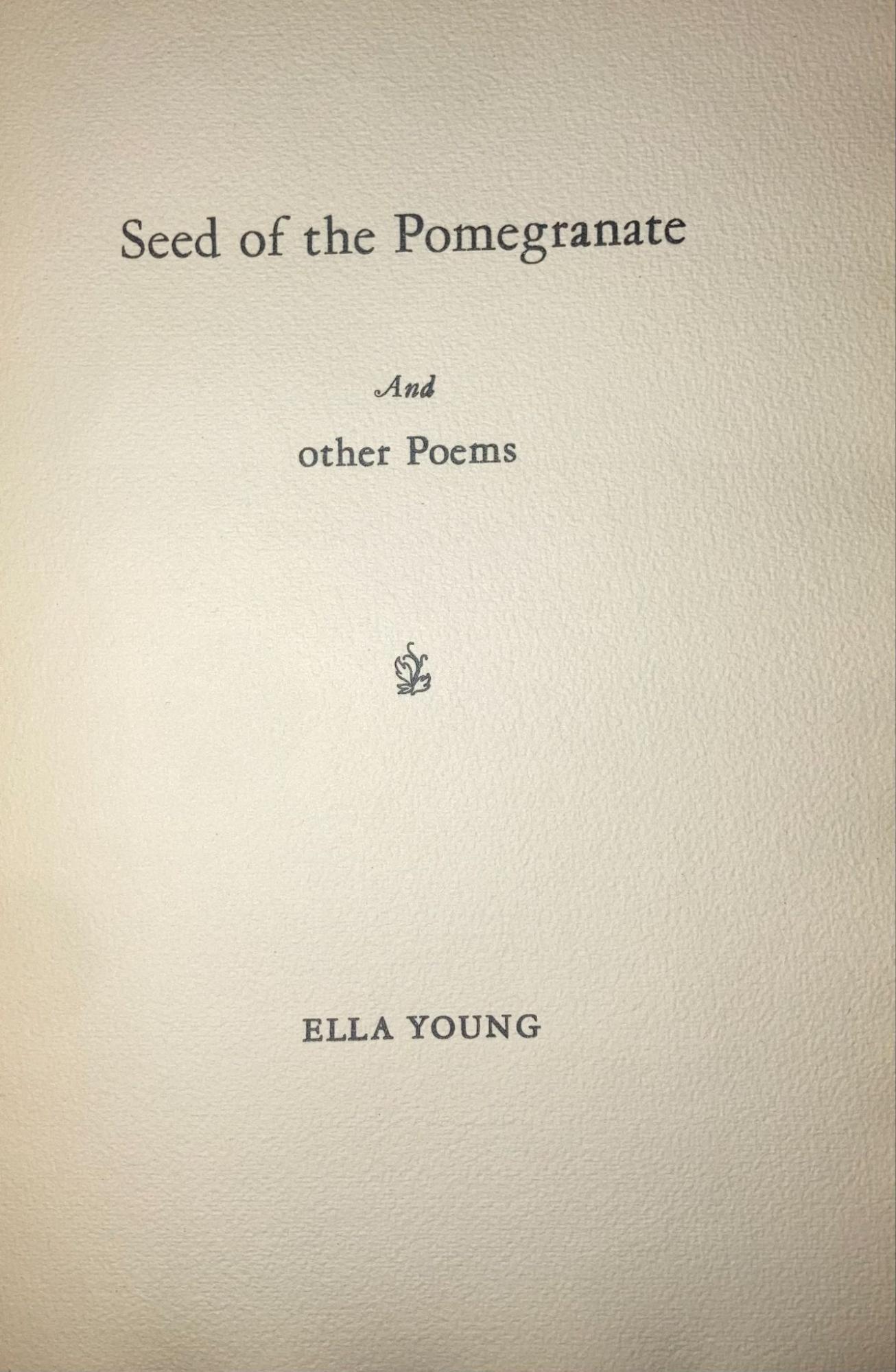
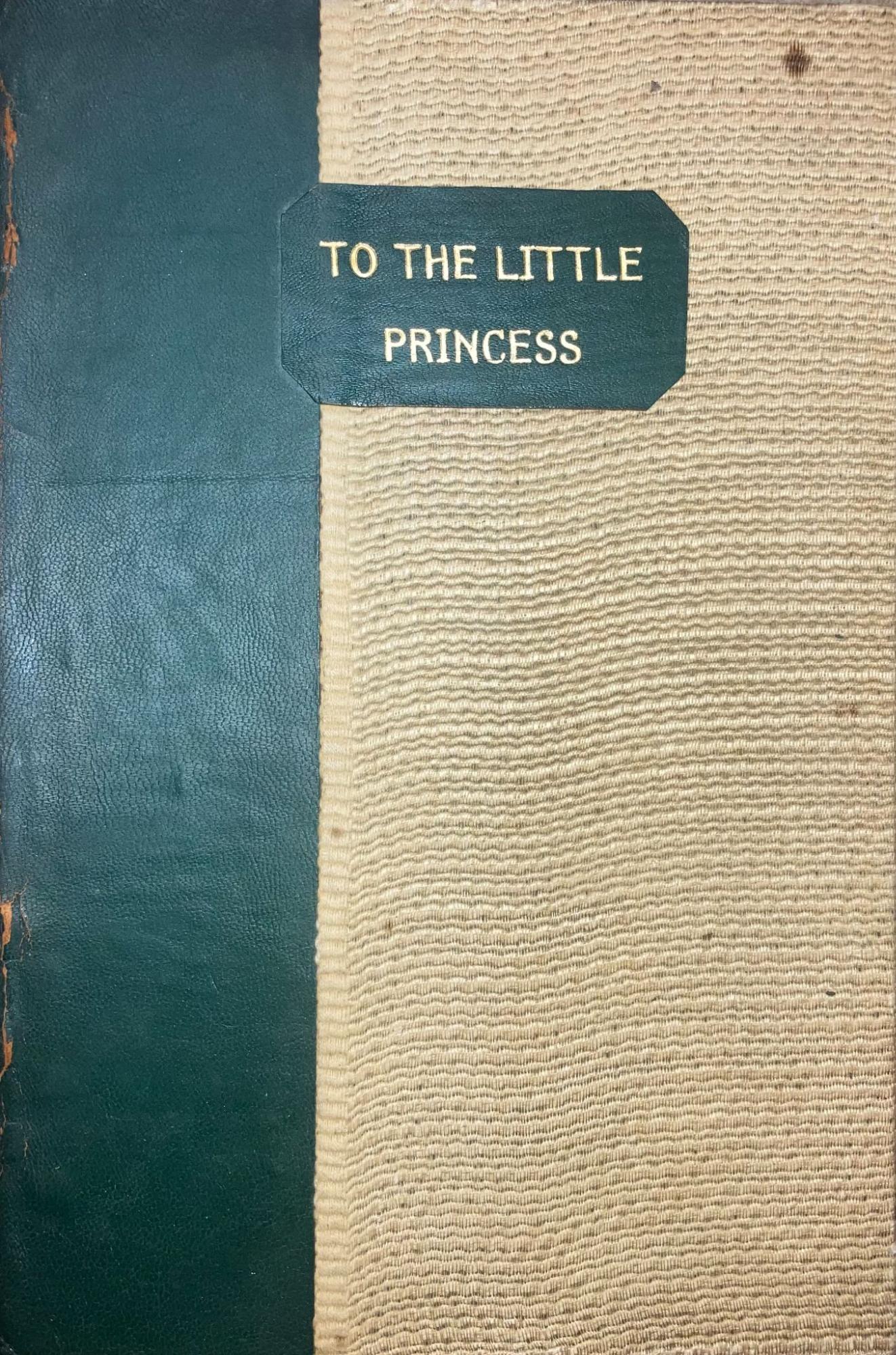
Here at AIHS, we have multiple copies of the works of Ella Young, donated in 2017 by Anastacia Gourley, a storyteller and performer who was inspired by Young in her own work and curated this collection. Though Gourley’s relationship with these works was particularly unique, it is also true that many hold a special place in their hearts for her work. As a writer of children’s stories, there are countless Irish (and non-Irish) children who have grown up with her writing and learned to love the magical world she saw around her.
In our collection, which is largely of poetry, Young explores nature, her changing home, personal feelings, and the lore and legends she loved so dearly. These works were influenced both by the landscapes of Ireland and of California, marking her connections to each part of her life.
By 1931, Young still had not been granted citizenship, and author C. E. S. Wood suggested she go to Canada in order to restart the process. Still, her application was denied for months. Though she returned to California, her continued admission of belief in the mystical and–more crucially–her meetings with American socialists and radicals caused a challenging relationship with the American government. As far as records show, she was likely never granted full citizenship, though the American people accepted her as their own.
She remained in California until her death in 1956, after a long battle with cancer. While she is still fondly remembered by those in Ireland, her greatest supporters are those Californians who remember her work as an American. This includes Linda Rosewood, who created the Ella Young Society, and UC Berkeley itself[2], who will always remember her lectures fondly. Young’s grave is marked in Santa Maria, California. The majority of her will was left to fund the efforts preserving the redwoods of Northern California.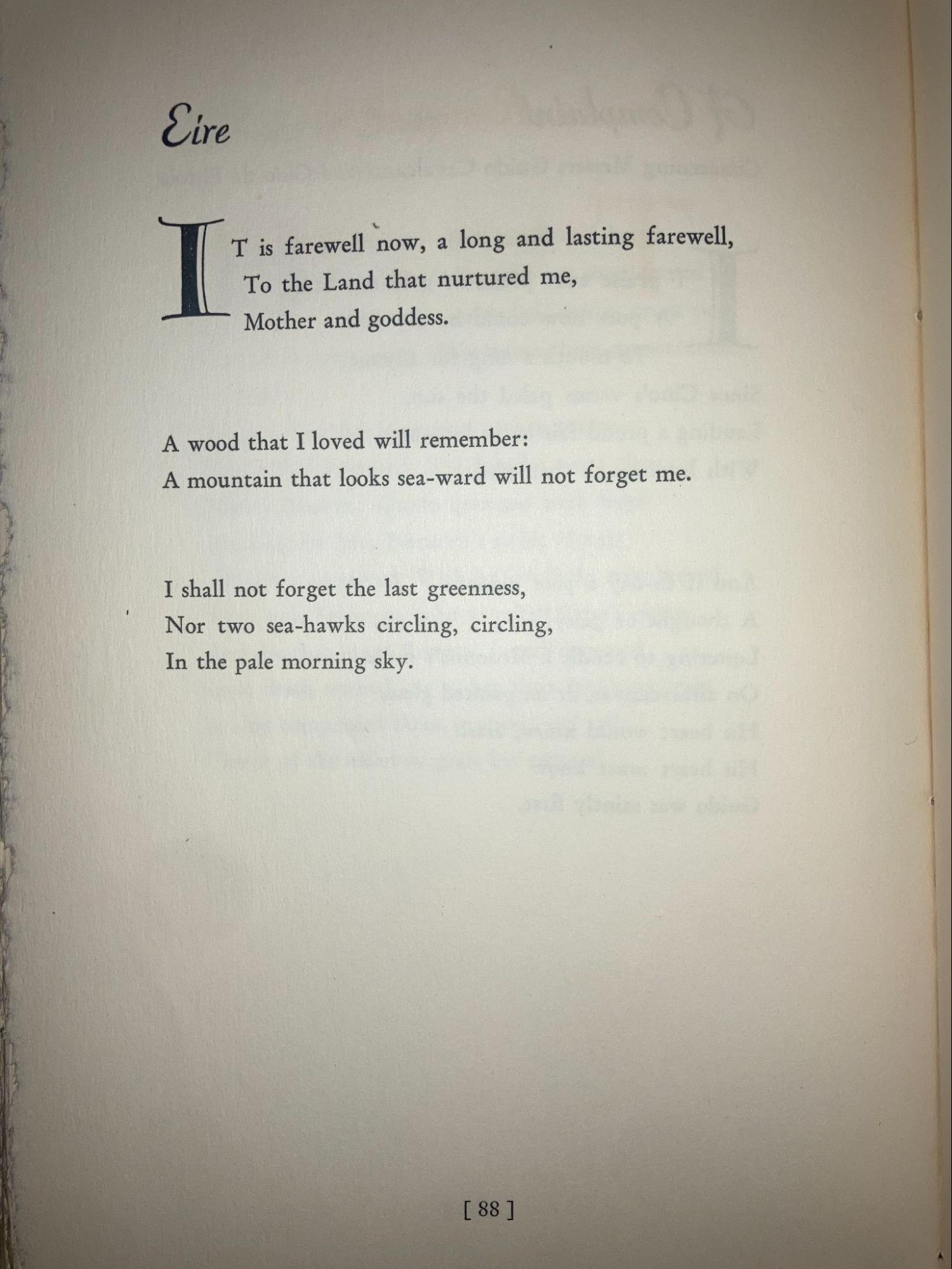
[1] “Elfland Sends an Ambassadress to Us; She Is Ella Young, a ‘Living Link’ with the Famous Eery Folk Hidden in the Landscape of Ireland (Published 1925).” New York Times, 18 Oct. 1925, www.nytimes.com/1925/10/18/archives/elfland-sends-an-ambassadress-to-us-she-is-ella-young-a-living-link.html.
[2] “Forgotten Chapters of Department History: #1 Ella Young’s Lectureship.” English, 22 Dec. 2023, english.berkeley.edu/news/forgotten-chapters-department-history-1-ella-young%E2%80%99s-lectureship.