
Editor’s Note: This article is a shortened version of a longer paper that can be found in our journal of undergraduate research, An Cartlann Gael-Mheiriceánach. This paper was created by an AIHS intern during a semester-long research project.
Seamus O’Brien was born in Cork, Ireland, in 1880 and was an Irish playwright, author, and fabulist. O’Brien spent a good amount of his life working in Dublin, Ireland, and later moved to New York and New Jersey, and spent some time in San Francisco in his 40s and 50s. During his career in Dublin, O’Brien completed substantial work with the Abbey Theatre and was heavily involved in the Irish Literary Revival, as evidenced by his correspondence with well-known figures in the movement. His work in Dublin was also completed during the Irish Revolutionary Period, which both inspired O’Brien’s work and influenced its success and popularity.
In his career, O’Brien was best known for his book “The Whale and the Grasshopper,” published in 1916, and his play “Duty,” which premiered in 1913. He was known for his work with one-act plays and Irish Satirical comedy. A collection of “Duty and Other Comedies” in the American Irish Historical Society’s archives provides insight into who O’Brien was as a playwright and his style of writing. The collection includes a short description of O’Brien’s writing, noting its “Rich Irish humor and delightful philosophy” (Little, Brown, and Company), In addition, it highlights his one-act plays as “notable for hilarious situations, clever character drawing, and bright dialogue, some of it so delicious as to bear comparison with the talk of Thomas Hardy’s country folk” (Little, Brown, and Company). This description makes it evident that O’Brien’s writing style included humor that resonated with its audience.
It is important to note that O’Brien was working in Dublin during the Irish Revolutionary Period. This period included many major events, including the Easter Rising in 1916, the War of Independence from 1919 to 1921, the Anglo-Irish Treaty in 1921, and the Irish Civil War from 1922 to 1923. With these events, this period was one of massive social division, chaos, and violence, as many were fighting for the Irish Home Rule movement and to be released from British political dominance and control.
The Irish Literary Revival was heavily connected to the Irish Revolutionary Period. The Revival focused on reviving folklore, mythology, literature, and plays within Irish history and by Irish individuals. This movement was revolutionary in its own right, influenced and motivated by the Irish Revolutionary Period to resist British cultural dominance, embrace Irish culture, and fight for the Home Rule movement. The literary revival served as an outlet for revolution and resistance and often sparked much controversy.
There were many key figures involved in the Irish Literary Revival, most notably, W.B. Yeats, George Russell, and Lady Gregory. On top of this, there were numerous lesser-known playwrights, authors, and artists involved in the movement, each unique and distinctive in their own way. However, because the movement came with so much passion and invited so many people, it became difficult to remember and appreciate every single one of them.
The Abbey Theatre in Dublin was one of the largest and most influential spaces and outlets for work to be shown during the Irish Literary Revival and was involved in the fight for Irish independence. The theatre was founded in 1904, and according to a book by Gerald Fay, The Abbey Theatre, it was founded by “men and women of talent and determination and was intended to be run on lines which would ensure integrity and a certain amount of continuity” (Fay 45). Fay highlights that the theatre was, at its core, a place to celebrate, enjoy, and put forward Irish playwrights and actors.
In addition, with the enormous passion among individuals in Ireland to both fight for home rule and for Irish cultural independence, the Abbey Theatre attracted many eager to present their own playwrights to the rest of Dublin. When O’Brien’s play “Duty” premiered in 1913, there were already many plays that were being continually shown, as well as new plays being produced and performed for the first time. In 1913, 16 new plays premiered at the theatre, along with O’Brien’s “Duty.” These newly produced plays included works by names such as Joseph Connolly, Seamus O’Kelly, Gertrude Robins, and many more.
“Duty” is a one-act play set in a country public house run by Mrs. Cotter, the public housekeeper. The play includes 6 characters in total and begins with Mrs. Cotter, serving two characters, Micus and Padna, drinks, despite the drinking laws in effect during the time regarding certain drinking hours and drinking on Sundays. As Micus and Padna are drinking, an officer knocks on the door asking to be let in. Micus and Padna quickly hide as Mrs. Cotter answers the door, invites the officer in, and offers him a drink. The Officer accepts and begins to drink when another police officer knocks on the door. The first officer goes to hide while Mrs. Cotter lets the other officer in and offers him a drink, which he accepts. The play continues in this cycle until they are all caught, ending the play on a cliffhanger as to whether the head officer will press charges as he comically and ironically states, stating, “To think that you’d dare attempt to interfere with me in the discharge o’ me duty!” (O’Brien 36).
The play is mostly a satirical comedy mocking the R.I.C., but it also has substantial hidden revolutionary elements, specifically in the songs Padna and Micus sing throughout the play. At different points, Padna and Micus sing lyrics to the songs “We are the Boys of Wexford,” and “The Memory of the Dead,” both of which are Irish rebel ballads commemorating the Irish rebellion of 1798, and sing lyrics to “A Nation Once Again,” an Irish rebel song. For context, the Irish rebellion was an uprising against British control over Ireland, and in support of Irish Catholics against discrimination.
Through these songs, O’Brien places substantial revolutionary sentiment in his play, which would have most definitely connected and resonated with the audience, as unrest and frustration were growing with the Easter Rising less than three years away. The simple memory of such ballads in the play would remind the audience of their country’s past and the need to continue fighting for their country.
The play’s cast also included well-known actors and actresses whom the audience would have recognized, and perhaps played a part in the play’s initial success at the Theatre. Una O’Connor, who played Mrs. Cotter, had been working with the Theatre for two years before she performed in “Duty.” While O’Connor gained most of her popularity from her role as the housekeeper in “Bride of Frankenstein” in 1935, she was still a very involved actress whom the audiences would have recognized. In addition, Joseph Kerrigan, who played Micus in the premiere, had been acting in the Theatre since 1906, and Fred O’Donovan, who played Sergeant Dooley (one of the R.I.C. officers), had been acting in the Theatre since 1908, as well as working as a director and general manager. In addition, Lennox Robinson, the director of the play, had already been heavily involved in the theater since 1909, directing many substantial productions (Irish Theatre Institute). The actors, actresses, and director of the premiere would have been familiar faces and names to the audience, perhaps further incentivizing them to see the show.
Multiple letters within the Seamus O’Brien correspondence collection, housed at the American Irish Historical Society, illustrate O’Brien’s initial success with “Duty” at the Abbey Theatre.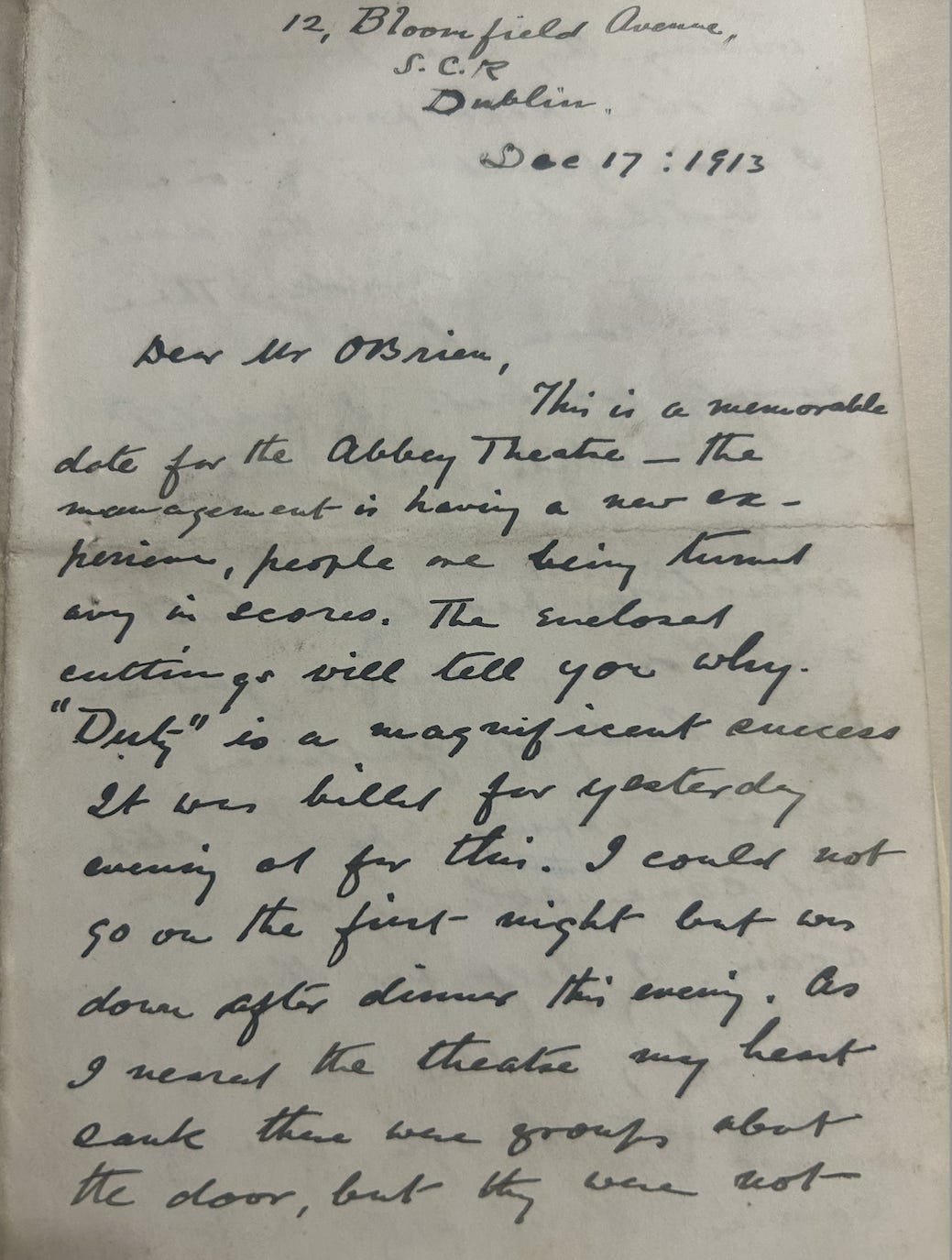
William Buckley to Seamus O’Brien, December 17, 1913. Seamus O’Brien Correspondence Collection, Box 1, Folder 2, AIHS Archives, NY, NY.
The image above features a letter to Seamus O’Brien from William Buckley, a close friend to O’Brien, dated December 17th 1913. In the letter, Buckley writes, “Duty is a magnificent success,” and later, “You will be the most talked of man in the capital of Ireland tomorrow” (Buckley). The letter not only captures the success of O’Brien’s play at the time but also highlights an expectation for O’Brien to become very well known due to the popularity of the play, so much so that Buckley speculates he will be known throughout Dublin by the following day.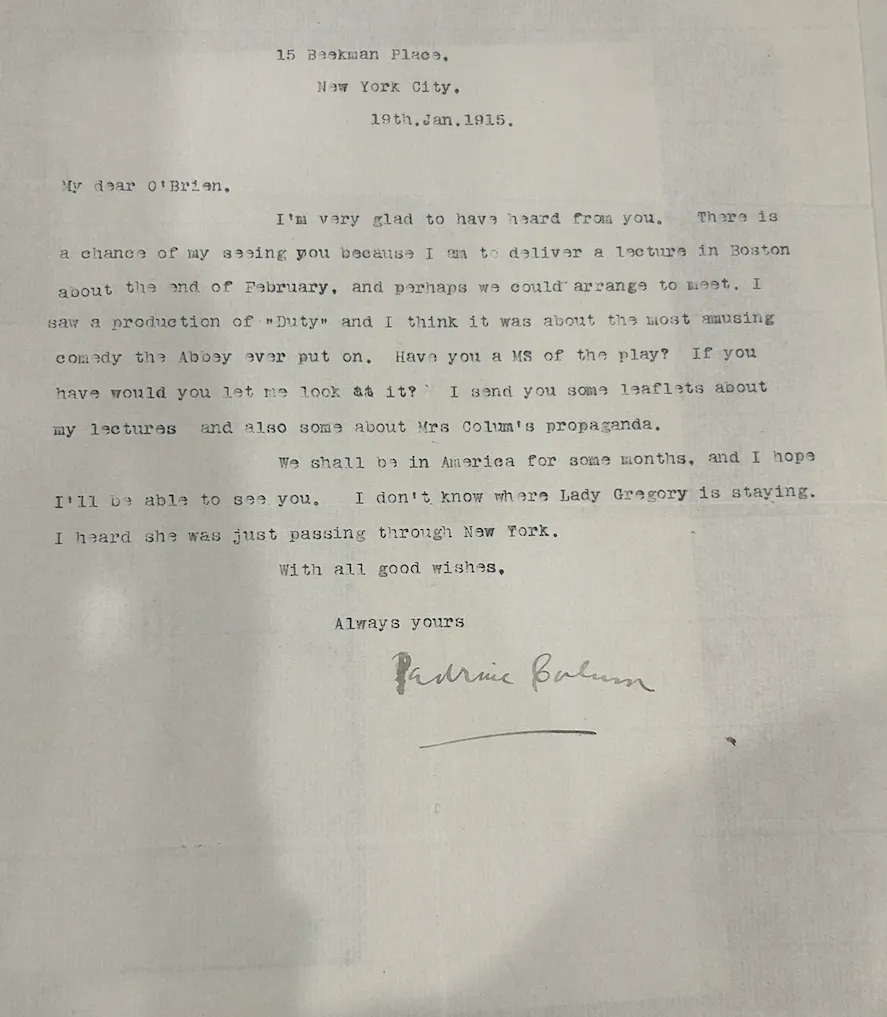
Padraic Column to Seamus O’Brien, January 18, 1915, Box 1, Folder 3, AIHS Archives, NY, NY.
Later on, a letter from January 18th, 1915, pictured above, illustrates further success and praise of “Duty.” The letter is from Padraic Column as he writes, “I saw a production of ‘Duty,’ and I think it was about the most amusing comedy the Abbey ever put on” (Column). The letter not only further solidifies the fact that O’Brien was having substantial success within the Theatre and his play, but it also provides proof of O’Brien’s relationship and involvement in the overall Irish Literary Revival through his correspondence with famous names, such as Padraic Column.
Through an examination of O’Brien’s correspondence, it is evident that his play had great success in the first few years of its run and that many expected O’Brien to continue to become a well-known playwright. However, other letters within his collection reveal criticisms some of his other plays and works faced, and can provide insight into why he is not as well-known today despite the clear success of “Duty.”
A letter from 1913 from the Abbey Theatre to O’Brien highlights both criticisms of one of O’Brien’s other plays and acceptance of his play “Duty.”
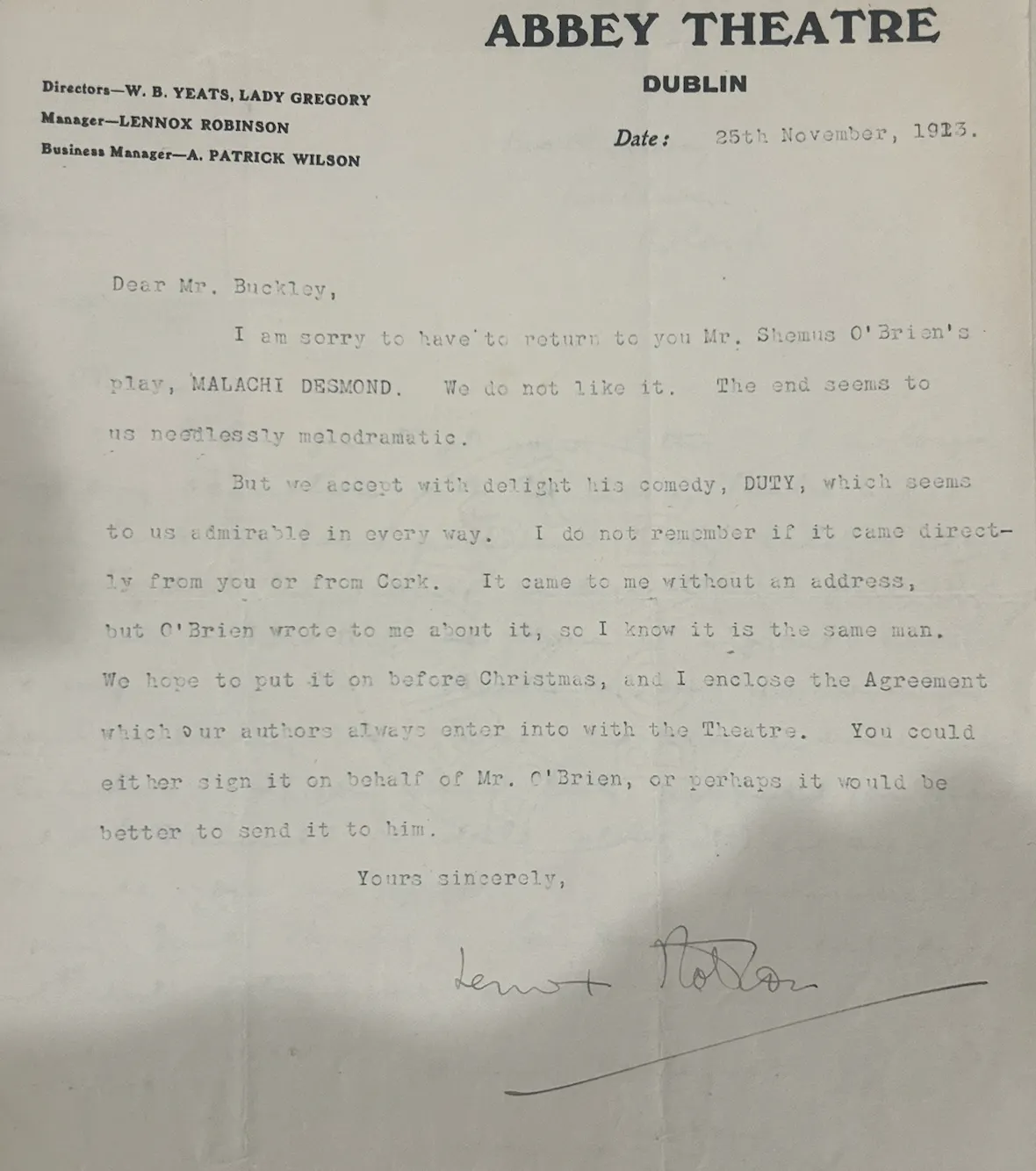
Abbey Theatre to Seamus O’Brien, 35 November 1913, Box 1, Folder 2, AIHS Archives, NY, NY.
The letter, pictured above, from the theater writes, “I am sorry to have to return to you Mr. Seamus O’Brien’s play ‘Malachi Desmond.’ We do not like it. The end seems to us needlessly melodramatic,’ but later writing, ‘We accept with delight his comedy ‘Duty,’ which seems to us admirable in every way” (Abbey Theatre). The Abbey’s criticisms of the play ‘Malachi Desmond’ as “needlessly melodramatic” may allude to the play’s lack of ability to evoke emotion amongst the audience, and seeming overly or theatrically dramatic for no reason. This can be interpreted as the Abbey seeking alternative texts that were dramatic in ways that would resonate with the audience, and perhaps more revolutionary.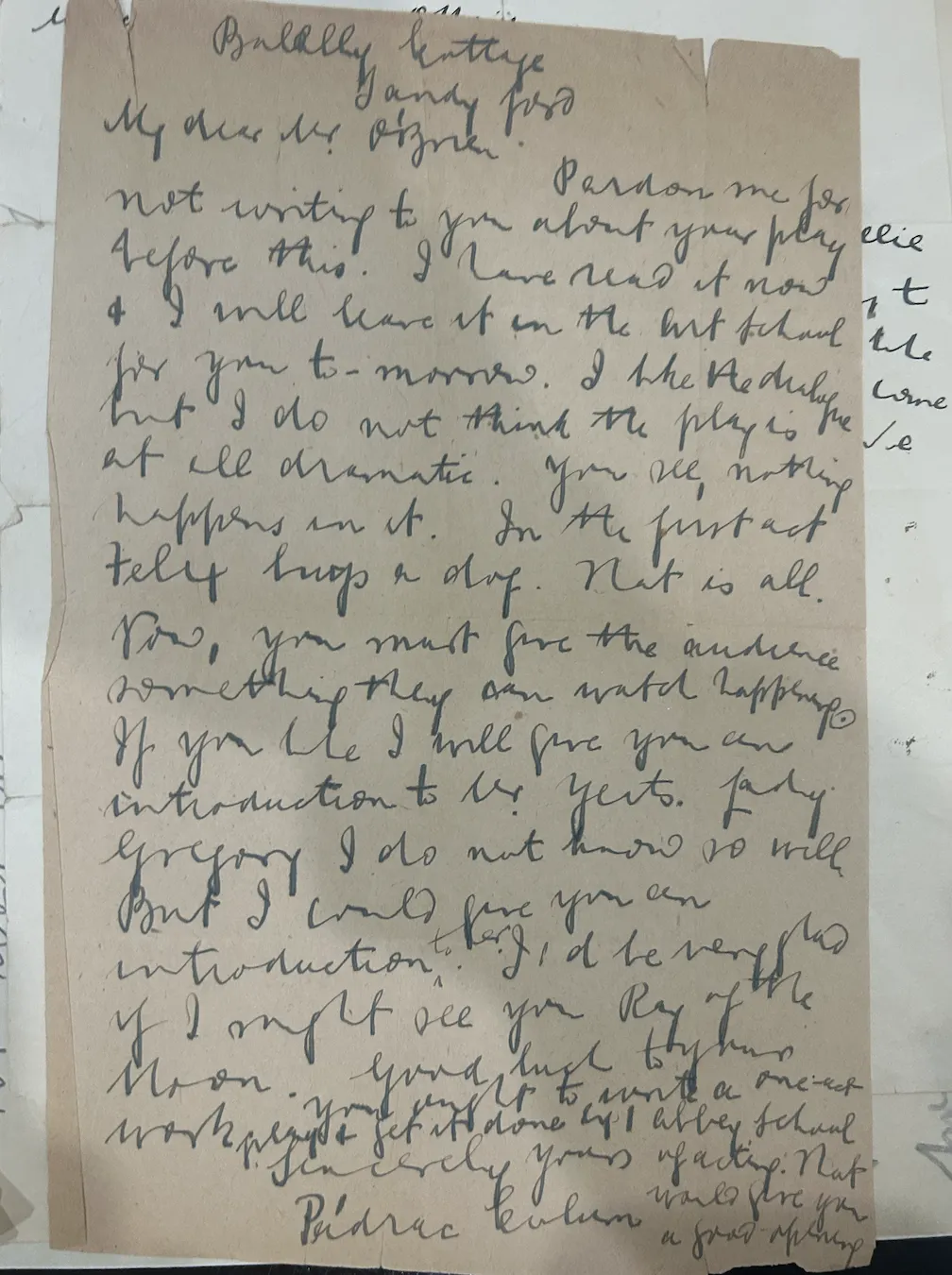
Padraic Column to Seamus O’Brien, Box 1, Folder 2, AIHS Archives, NY, NY.
Finally, another letter from Padraic Column to O’Brien refers to another one of O’Brien’s plays, saying, “Pardon me for not writing to you about your play before this… but I do not think the play is at all dynamic, you see, nothing happens in it” (Column). The use of the word dynamic here may relate to the fact that it was not revolutionary enough, being instead halfhearted or lethargic, and would not resonate with its audience at a level that was “revolutionary enough.”
Ultimately, the reason O’Brien is not as well-known today is not that he wasn’t a talented writer; rather, it can be attributed to two main reasons. Firstly, the time period when O’Brien was working saw so many revolutionary developments during the Irish Revolutionary Period that it may have reached the point where nothing seemed revolutionary enough. Secondly, the Irish Literary Revival attracted so many individuals, fueled by passion and motivation, that it became difficult to recognize each playwright for their own distinctive talent, and it is difficult to remember each of them today.
What O’Brien’s work shows us today is the importance of looking back on playwrights, authors, or artists who were involved in pivotal times, such as the Irish Literary Revival and the Irish Revolutionary period, that may have been overlooked simply because there are so many insightful and talented artists. O’Brien’s work and that of playwrights today are remembered for their ability to comment on the social and historical context of the time while creating unique, hilariously funny plays that kept the audience engaged through their notable one-act length.
Author Bio:
Evelyn Burkholder is a Junior at Fordham University, majoring in English and history and minoring in Italian. She is interested in Irish history, and particularly the Irish Literary Revival. In addition, she is heavily passionate about folklore and how fables and stories influence culture and society. She hopes to continue working in archives in the future.