
By Marcus Lindenburg
Joan Fitzgerald (1930-2024) was born in Chicago, IL in 1930 to parents of Irish heritage on both sides. Her mother, whose maiden name was Cunneen, was born in Chicago to parents from Co. Clare. Fitzgerald herself was eager to connect with Europe, though her passions drew her to continental Europe, and what it had to offer her as a training artist. Developing an early interest in the arts, she rose quickly as a modern artist with aspirations of global acclaim.
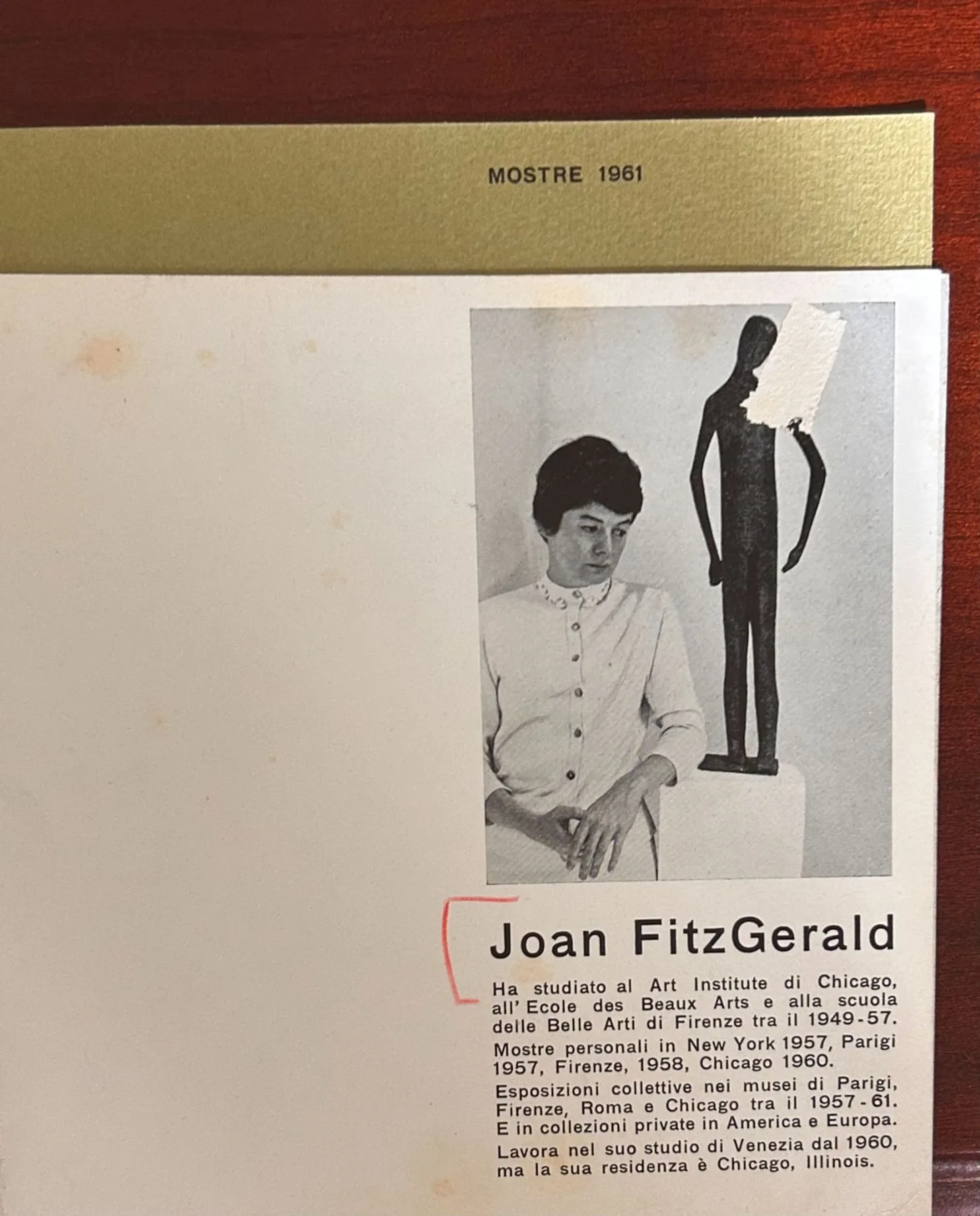
Joan Fitzgerald, pictured in Italian Exhibit Catalog, American Irish Historical Society
Fitzgerald received her arts education at multiple schools, across the United States and later in Europe. Most notably in Chicago were De Paul University and the Art Institute of Chicago, both known for their robust arts education. Once Fitzgerald left Chicago as a young woman, she received more hands-on training at the Ecole des Beaux Arts in Paris, and the Scuola delle Belle Arti in Florence. The latter school had the greatest influence on her career, encouraging her to settle in Italy and develop her work by surrounding herself with sculptors.
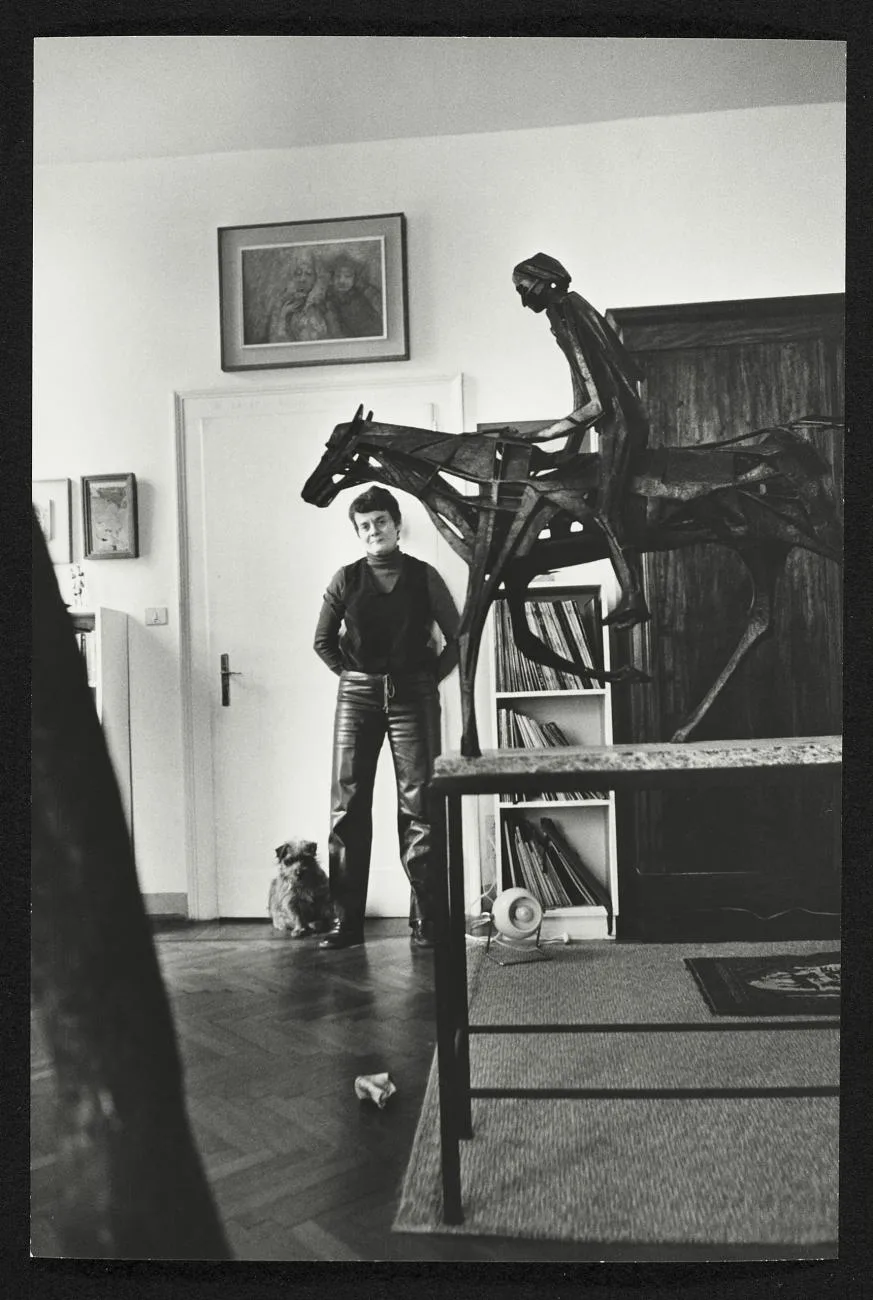
Fitzgerald in Studio, Russell Lynes. Joan Fitzgerald, 1977. Russell Lynes papers, 1930-1986. Archives of American Art, Smithsonian Institution.
Sculpture was her primary art form, and one that permitted her to engage directly with the physical world around her. In Venice, she had a permanent studio by the time she reached her thirties, as well as a bronze foundry that she could access to source materials. Though her works were almost exclusively in bronze, she was fascinated by the natural world and enjoyed recreating images of nature in striking, geometric form.
At the time of her discovery by the American art world (around the mid-1960s), abstract expressionism was already widely accepted by mainstream critics. In Ireland, female artists like Mainie Jellett (1897–1944) and Mary Swanzy (1882–1978) had already pioneered forms of modern art, redefining expression in the 1910s and 20s during periods of great change in the country. Yet in the second half of the twentieth century, there was still a desire to push beyond the norm and explore newer artists. Inspired by the works of her predecessors, Fitzgerald looked for ways to show the world around her in a new light.
Fitzgerald, like many emerging artists, had to push for her own recognition. In her earlier correspondence in the AIHS collection, letters like this 1961 note show her push to be discovered back in the United States. Not uncommonly for artists trained in continental Europe, Fitzgerald had to seek her place in the United States despite being an American. Though she was an artist, she had to work equally as a businesswoman, promoting her own works to interested parties and finding connections to build her network.
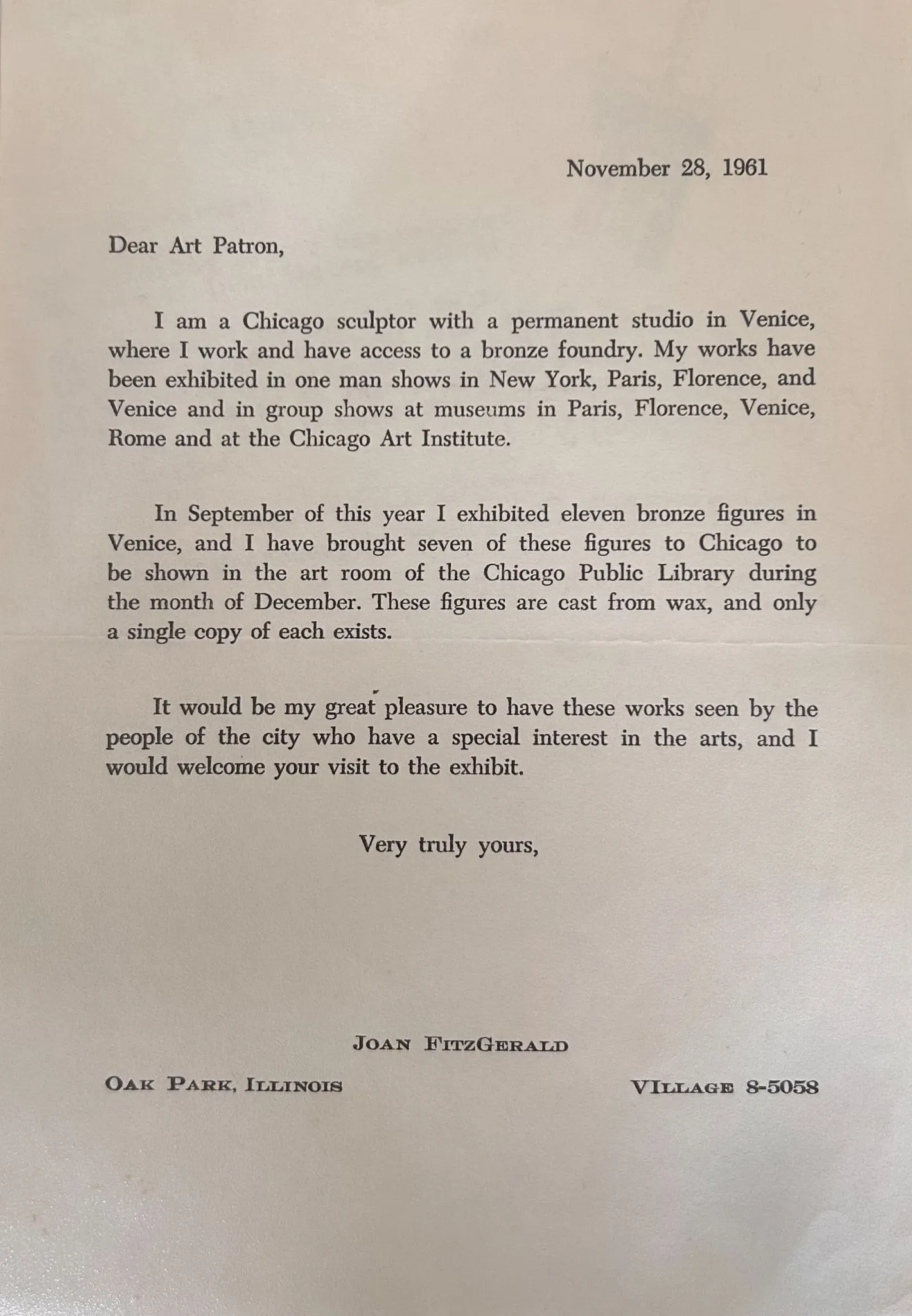 Joan Fitzgerald Correspondence Collection, American Irish Historical Society
In catalogs like the one below, Fitzgerald’s work is clearly not the highlight of the collection. But by showing her work in more shows, she gradually built up a name for herself to bring her work back to the states in larger venues. Once she had received praise from some of the more noteworthy critics in Italy, she was able to move beyond the smaller references in exhibit catalogs and start to promote her own shows.
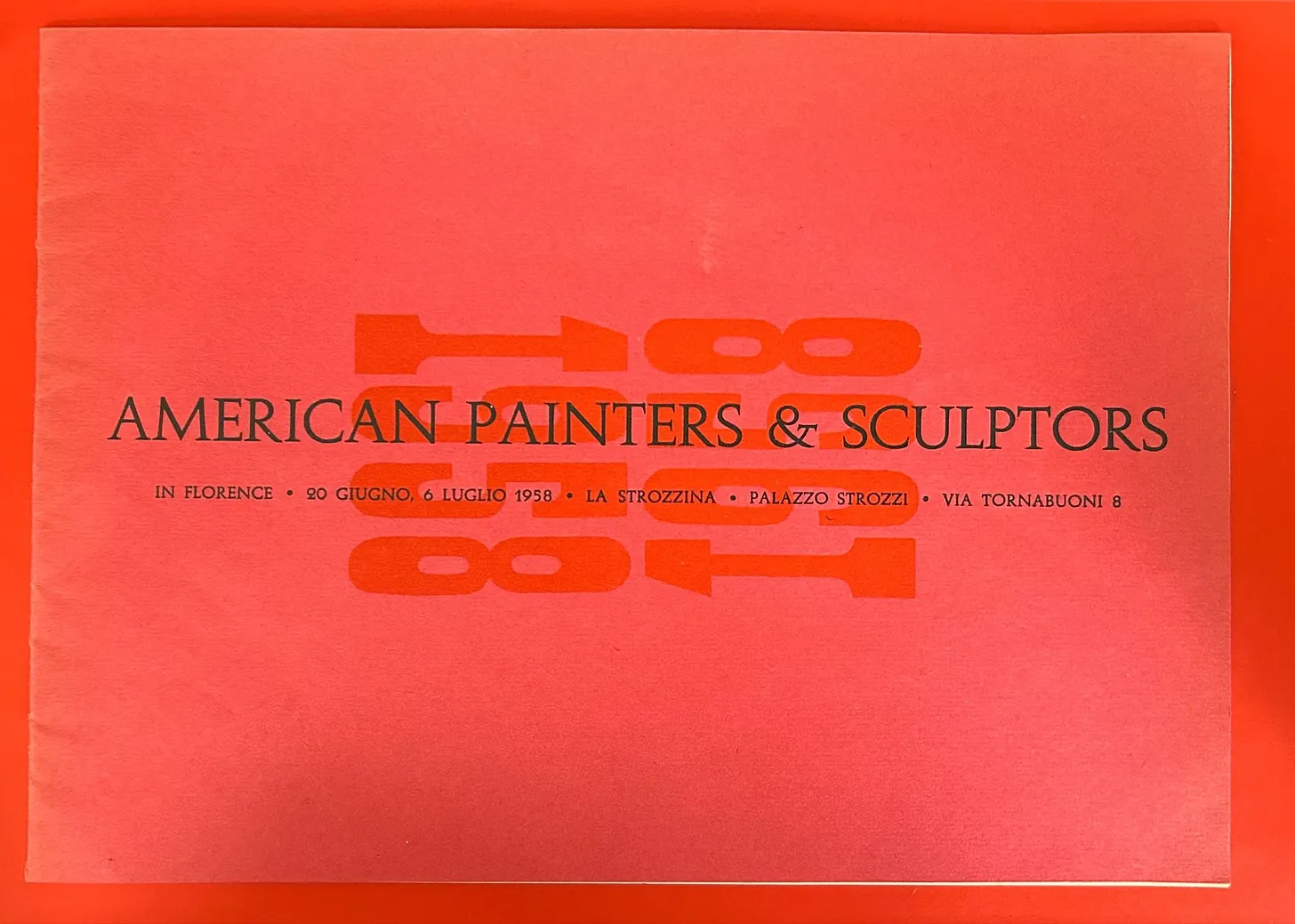
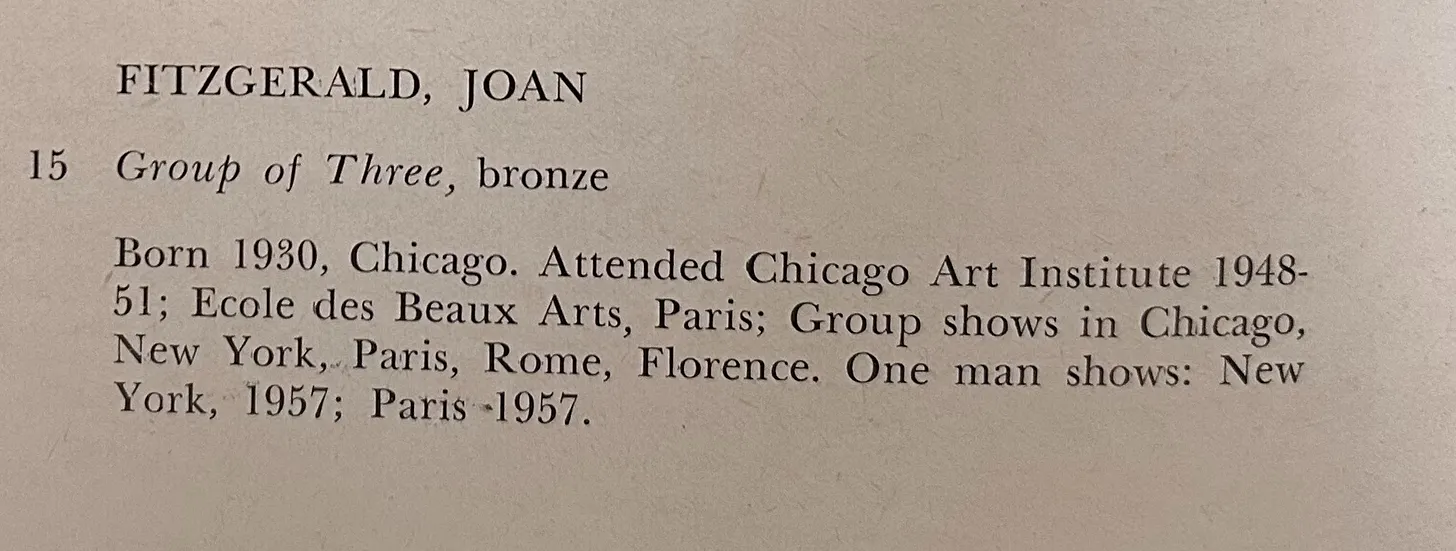
American Painters & Sculptors Catalog, Joan Fitzgerald Collection, American Irish Historical Society
As her work developed, her interests moved beyond the natural world, and she became more interested in the political and cultural world blossoming around her. She portrayed more human subjects, including portraits of figures like Time magazine Editor T.S. Matthews and boxer Muhammad Ali. She remained true to her interest in works of metal, though moved beyond abstraction into more figurative forms.
By the 1980s, she had exhibited across the States, including in her native Chicago. In 1981, she brought her work back to her Irish-American roots through an exhibit held in our collections. Exhibiting across the street from the Metropolitan Museum of Art in a crowd of proud Irish-Americans, she was recognized as not only an American sculptor or a European-trained artist, but as explicitly Irish-American.
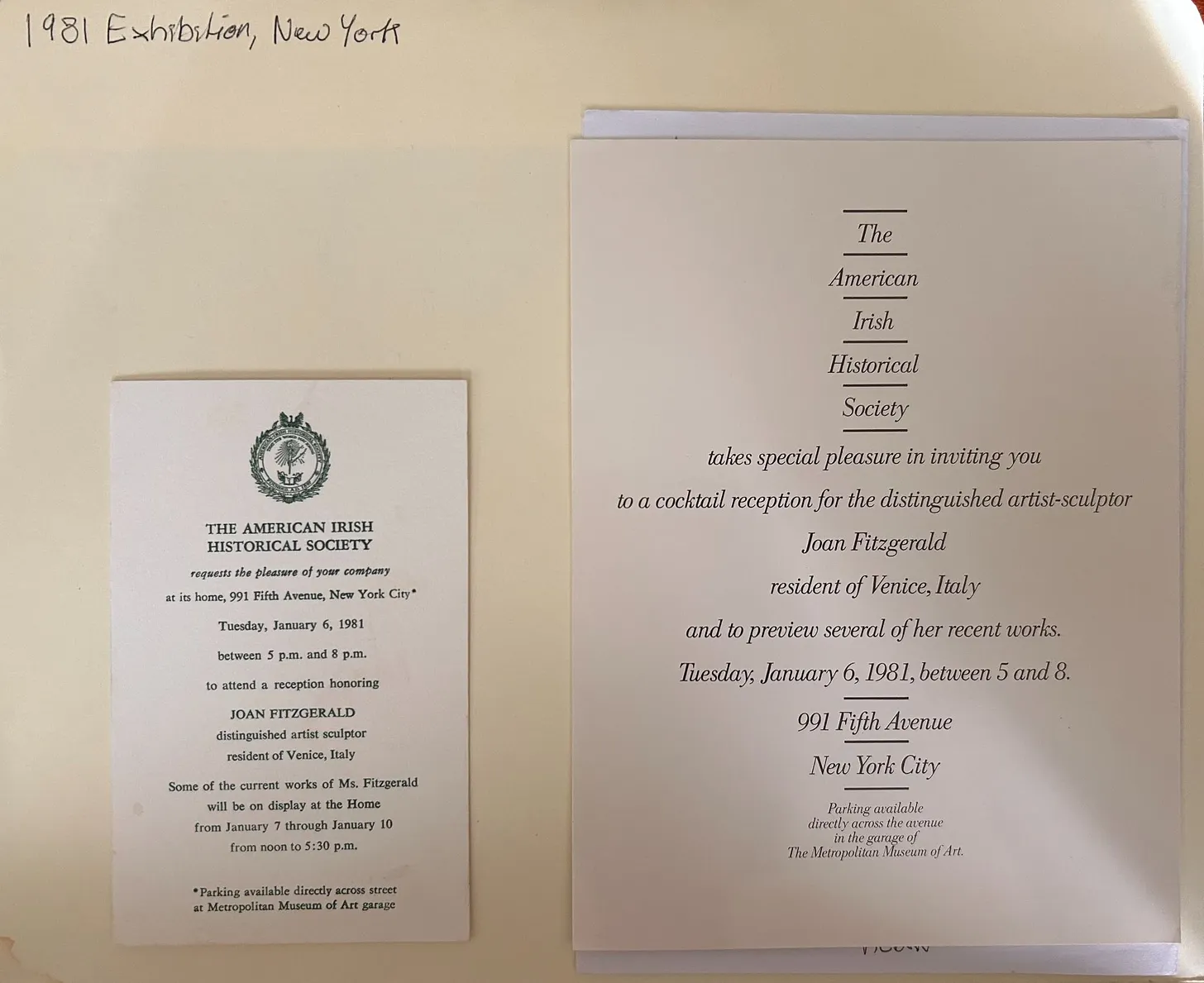
Joan Fitzgerald Exhibits Collection, American Irish Historical Society
As one of her first publicly Irish appearances, her relationship with the society became profound and seemingly reinvigorated an appreciation for her heritage. Fitzgerald donated a number of books to our library collection, showing her own collection of Irish subjects. Later in life, Fitzgerald reconnected with her Irish heritage in a number of ways, most notably by applying for (and receiving) Irish citizenship through her mother’s family.
Though it could be argued that Fitzgerald’s art was never explicitly Irish, her command of the natural world shares many themes with Irish folklore, literature, and art. Other pieces, like her Christ imagery in the below sculptures, echo themes of Catholicism that connect to many Irish and Irish-American experiences.
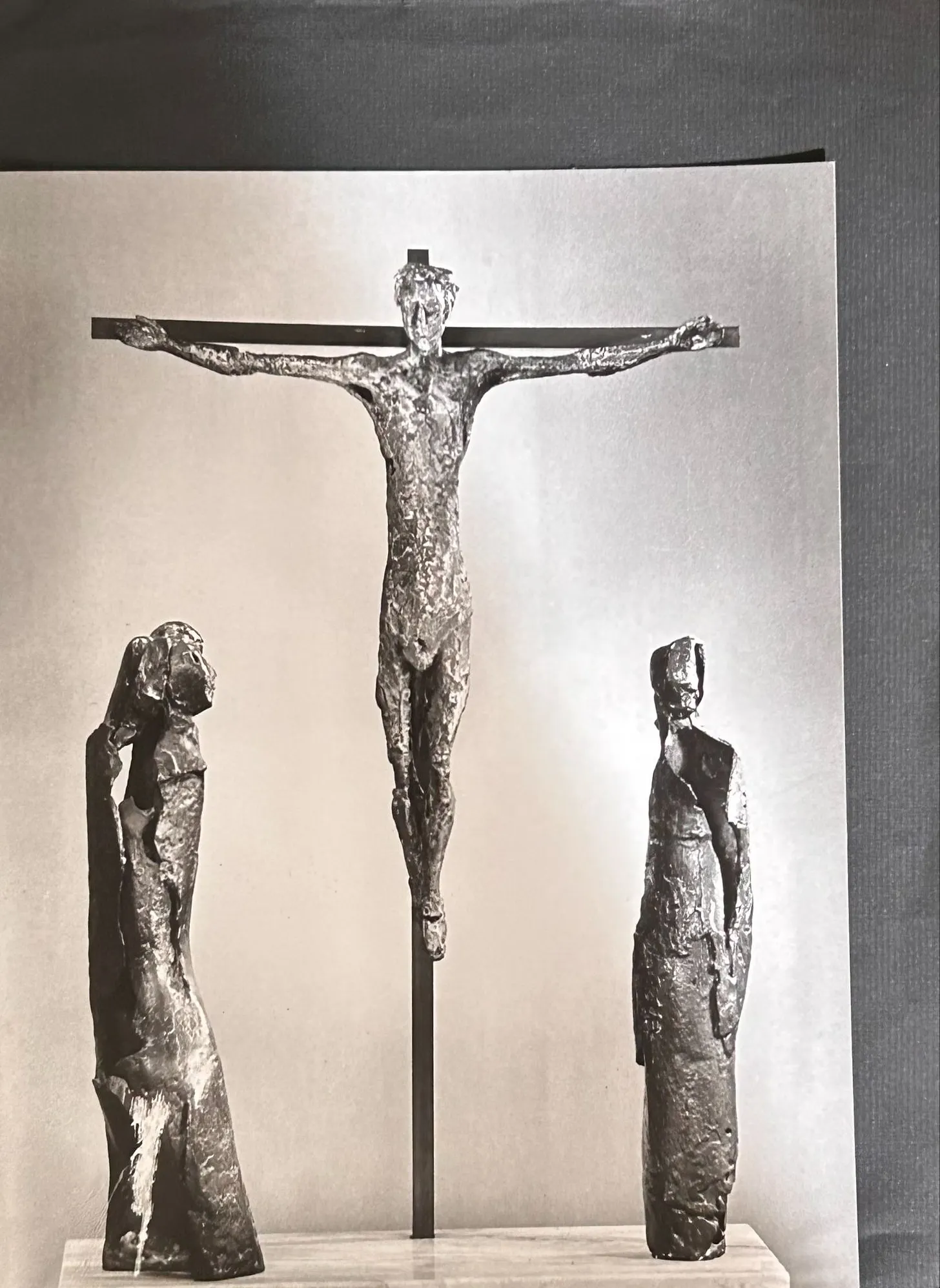
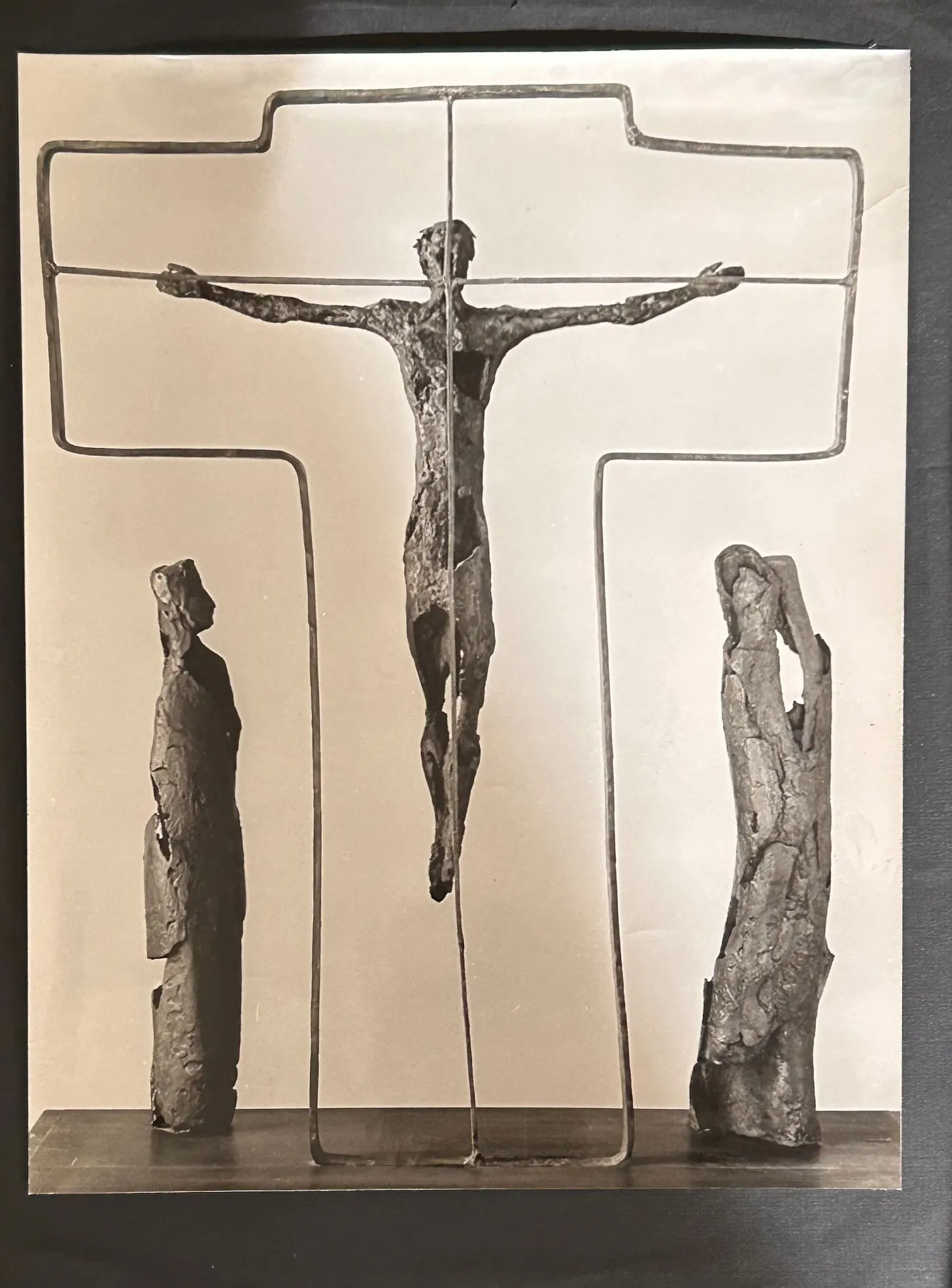
Joan Fitzgerald Exhibits Collection, American Irish Historical Society
Fitzgerald’s work can still be found at 991 5th Avenue for those with a careful eye. While present mostly in the correspondence and papers seen here, her smaller sculptures can be found elsewhere in our collection, including this sculpture of an Owl which she commemorated to Jack and Kathleen Flanagan.
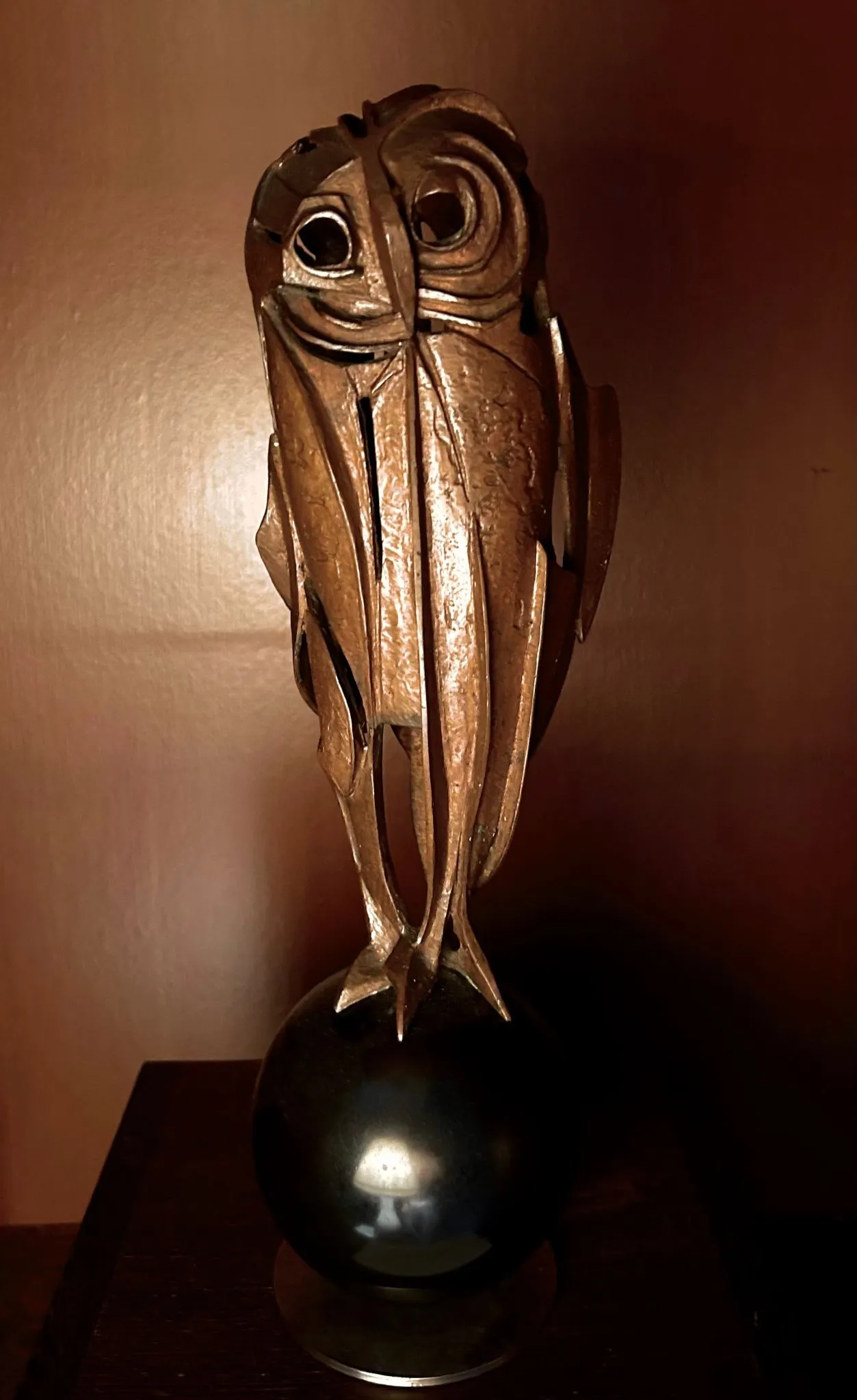 Owl, Joan Fitzgerald Collection, American Irish Historical Society