
By Audrey Chapin
Editor’s Note: This article is a shortened version of a longer paper that can be found in our journal of undergraduate research, An Cartlann Gael-Mheiriceánach. This paper was created by an AIHS intern during a semester-long research project.
The American Irish Historical Society (AIHS) archive includes materials that have been stored for a long time, but have never fully described or displayed. One such item is a handbound book with religious short stories in the Irish language, a pamphlet-size schoolbook for the second grade in Ireland, and some handwritten Irish language practice. It originates from the collection of the Gaelic Society of New York, evident from stamping throughout.
In the late 19th century, many groups formed to preserve Irish and Irish American history. In its early days, AIHS was primarily interested in collecting materials from such societies. One of these organizations was the Gaelic Society, which was specifically established to promote the Irish language, expanded from its Irish locations.
Based on the publication location of the short stories (London), and the explicit intention of the schoolbook included (Ireland), The Handbound Book, or perhaps its creator, was presumably from the United Kingdom. The only clear name repeated throughout The Handbound Book is Seamus, or anglicized James, McQuige. It is handwritten multiple times as well as printed on the schoolbook. McQuige was an Irish Methodist Preacher. He is the author of this schoolbook, printed by the Irish Baptist Society, and it includes a message from him in Irish and English.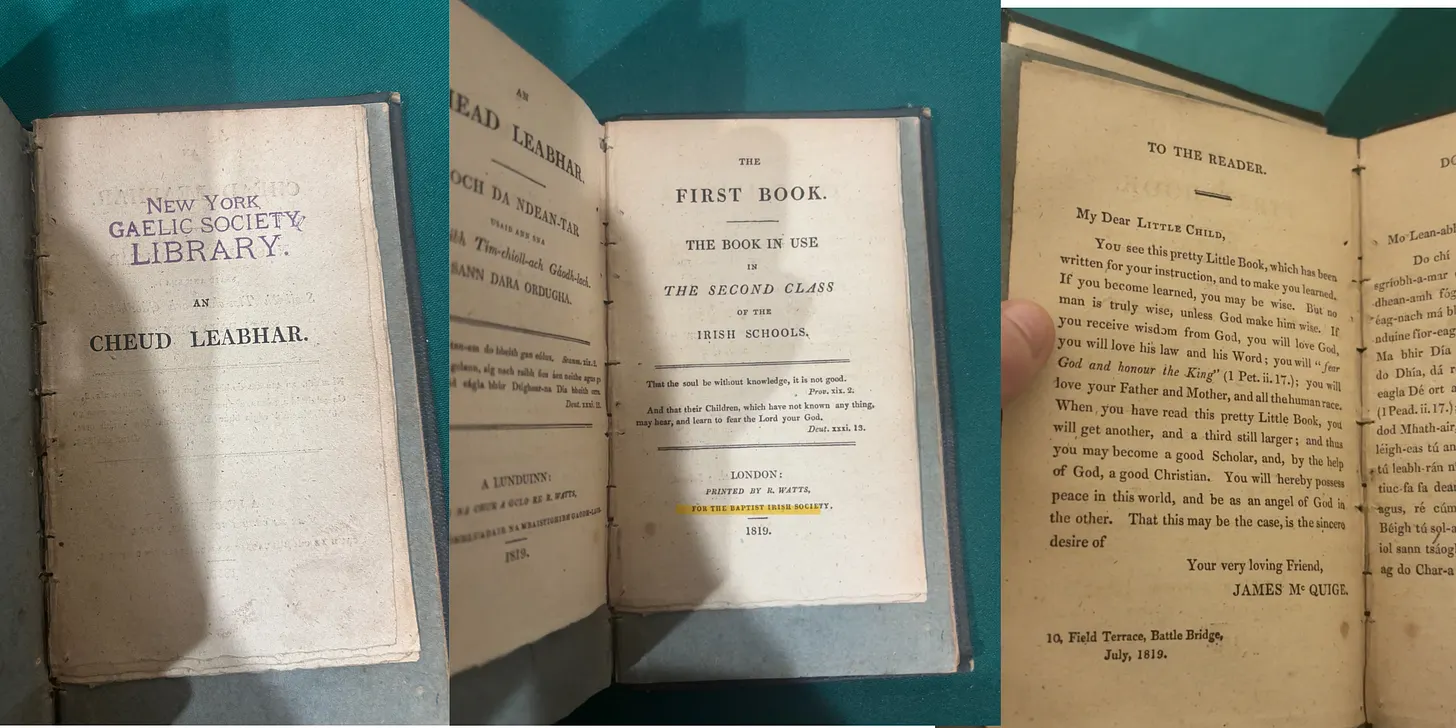
[James McQuige.png] Above Image: Excerpt from The Handbound Book; the first three pages of the schoolbook included in The Handbound Book. Source: The American Irish Historical Society Archives, New York, NY.
McQuige was an avid supporter of the Irish language and Christianity. In a letter from McQuige to Reverend Joseph Iviney, the Secretary to the Baptist Irish Society (which printed the schoolbook), he asks, “Must the gospel of the Son of God be denied to all this people, because it is acceptable to them only in the ancient and beloved language of their fathers?”
For McQuige, the Irish language was a tool to understand Christianity and know God.
One of the institutions that printed the short stories in The Handbound Book was the London Hibernian Society (LHS). Similar to McQuige’s intentions, LHS established schools “to give [Irish people] Scriptural instruction.” This is in part because they deemed that most people in Ireland did not read and had misconceptions about the scriptures. For the LHS, Irish people were prejudiced against the Bible. The LHS believed that schooling was the appropriate method to change this. And thus, they deemed that the benefits of this scriptural education “in a country circumstanced like Ireland, [is] almost impossible to calculate.”
In the LHS’ “Brief View of...Establishing Schools and Circulating the Holy Scriptures in Ireland,” the Society clarifies that “No teacher is to obtrude on the attention of his Pupils the peculiarities of his religious denomination. He is, however, to require their attention to the Grammatical import of their Reading Lessons and Tasks, and to the moral duties therein inculcated.”
Of course, there is no way to verify the real actions or intentions in the classroom, but it is worth noting that the teachers at LHS schools were not trained with the intention of converting their students. If the LHS published the religious stories in The Handbound Book with the same intention, we can gather that these stories were not explicitly for Protestant conversion.
Another institution that published the short stories in The Handbound Book was the Religious Tract Society (RTS). The RTS was a group founded in 1799 that published religious stories. They were explicitly interdenominational, but contrary to a contemporary understanding of the term, interdenominational in this period did not necessarily include Catholics nor Unitarian. The RTS administration was strictly Protestant. The denominations represented in the RTS were bonded by their distrust of Catholics and Unitarians. In order to gain a larger Anglican following, they published works by authors such as Legh Richmond, who wrote one of the short stories in The Handbound Book.
The specific people and institutions affiliated with The Handbound Book provide a nuanced story of its purpose. McQuige and the LHS intended to disseminate the Irish language as a tool for Irish people to know God, but the RTS was exclusionary. Thus, the Handbound Book was undeniably a tool to learn the Irish language, yet not necessarily for conversion.
Though The Handbound Book was not explicitly used for conversion, it is still worth looking at the works selected to be in an Irish language learner’s book. “The Story of the Black Servant,” written by Legh Richmond in the 1810s gives an insight into how Englishmen, and likely an Irish language learner, would’ve perceived race in the early 19th century.
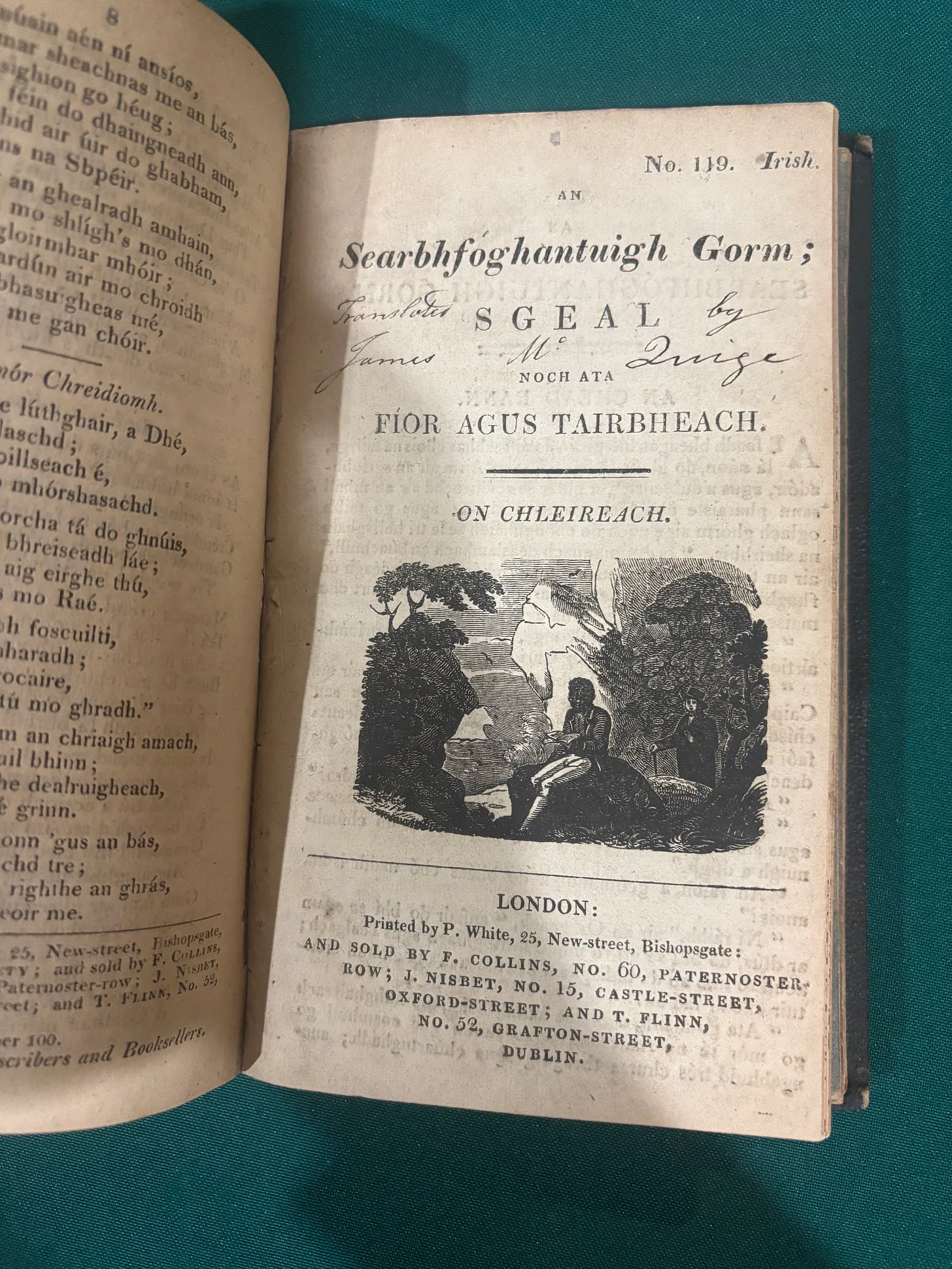
[The Story of the Black Servant.JPG] Above Figure: Excerpt from The Handbound Book; cover page of “The Story of the Black Servant” translated by James McQuige. Source: The American Irish Historical Society Archives, New York, NY.
“The Story of the Black Servant” is about William, a Jamaican man who escapes slavery and converts to Christianity. In the short story, the need for conversion is posited as a need to save souls. Richmond’s audience is obligated to follow his guidance. Additionally, Christians are called to end slavery despite the fact that it is perceived to be God’s will. The following is from the English translation:
“Slavery, as well of mind as body, has been continued amongst the Africans through their generations in a manner which at once proves the truth of the Divine prediction, and yet calls aloud for the ardent prayers and active exertions of Christians in their behalf.”
There is an abolitionist sentiment here on religious grounds, which aligns with the evangelical abolitionism to which Richmond was tied. Since this is a religious story and Richmond was an influential figure in England, The Black Servant can be read as a mandate for abolition. Richmond suggests that African-descended people should be free from enslavement but also tied to Christianity. He inspires other religious people, perhaps the user of this book, to convert others as a means to save their souls.
William is characterized as child-like to justify the paternalistic necessity of conversion. Richmond strips him of agency and complexity so that he is a blank slate for scriptural instruction. This innocence evokes sympathy and establishes a hierarchy wherein William is incomplete without Christian doctrine.
There is an air of fascination with William’s ‘simplicity’ and ‘sincerity’ reminiscent of 20th-century European primitivism. But this primitivism is progressive for the early 19th century. William is purer than the average sinner, and therefore a better Christian, possibly even better than white Christian. However, it is unlikely that the missionaries deemed that all prospects for conversion were already good Christians. As noted, Richmond and other English Protestant leaders thought of Catholicism as a threat and did not think highly of Irish people, though they saw them as equally uncivilized.
“The Story of the Black Servant” suggests that while the physical body should be free from enslavement, the mind and soul must remain bound to the structures of Christian orthodoxy. The character of William represents the paradox of paternalism. His soul is ultimately saved, but his interior life remains guarded by Western religious structures. Thus, there is never true freedom because it never evolves into genuine autonomy.
The Handbound Book found in the AIHS archives serves as a complex artifact of 19th-century linguistic and religious history. Likely compiled by individuals like Methodist preacher James McQuige, the book reveals a strategic use of the Irish language not merely for preservation, but as a bridge for Protestant scriptural instruction. While the contributing organizations varied in their level of anti-Catholic sentiment, they collectively viewed the Irish language as a vital tool to facilitate a student’s connection to God and to correct perceived scriptural misconceptions. This paternalistic framework is further evidenced by the inclusion of “The Story of the Black Servant,” which mirrors the era’s evangelical abolitionism. By characterizing its subject for conversion as simple, the book’s content establishes a hierarchy where physical or linguistic freedom is granted, yet the individual’s spiritual and intellectual autonomy remains strictly bound to Western Christian orthodoxy.
Author Bio:
Audrey Chapin is an Archives Intern at the American Irish Historical Society and a History and Catholic American Studies student at Fordham University. Her research explores the intersection of spirituality, enslavement, and dance, music, and storytelling.