
In New York, Brendan Behan is often remembered as a playwright with a reputation for drink, as well as for his earlier involvement with the Irish Republican Army. That reputation traces back to a series of events that began in 1939, when, at just sixteen, he was arrested in Liverpool carrying explosives for the I.R.A. and charged under the Prevention of Violence Act. He was sentenced to three years in a Borstal institution, a form of detention intended for young offenders, and released in 1941 on the condition that he be deported to Ireland. Within six months, he was arrested again in Dublin after firing on police officers. He was sentenced to fourteen years of penal servitude, of which he served roughly four before being released under a general amnesty. In 1947, he was arrested once more after returning to Britain on a forged passport in violation of his expulsion order, and served an additional four months in prison.
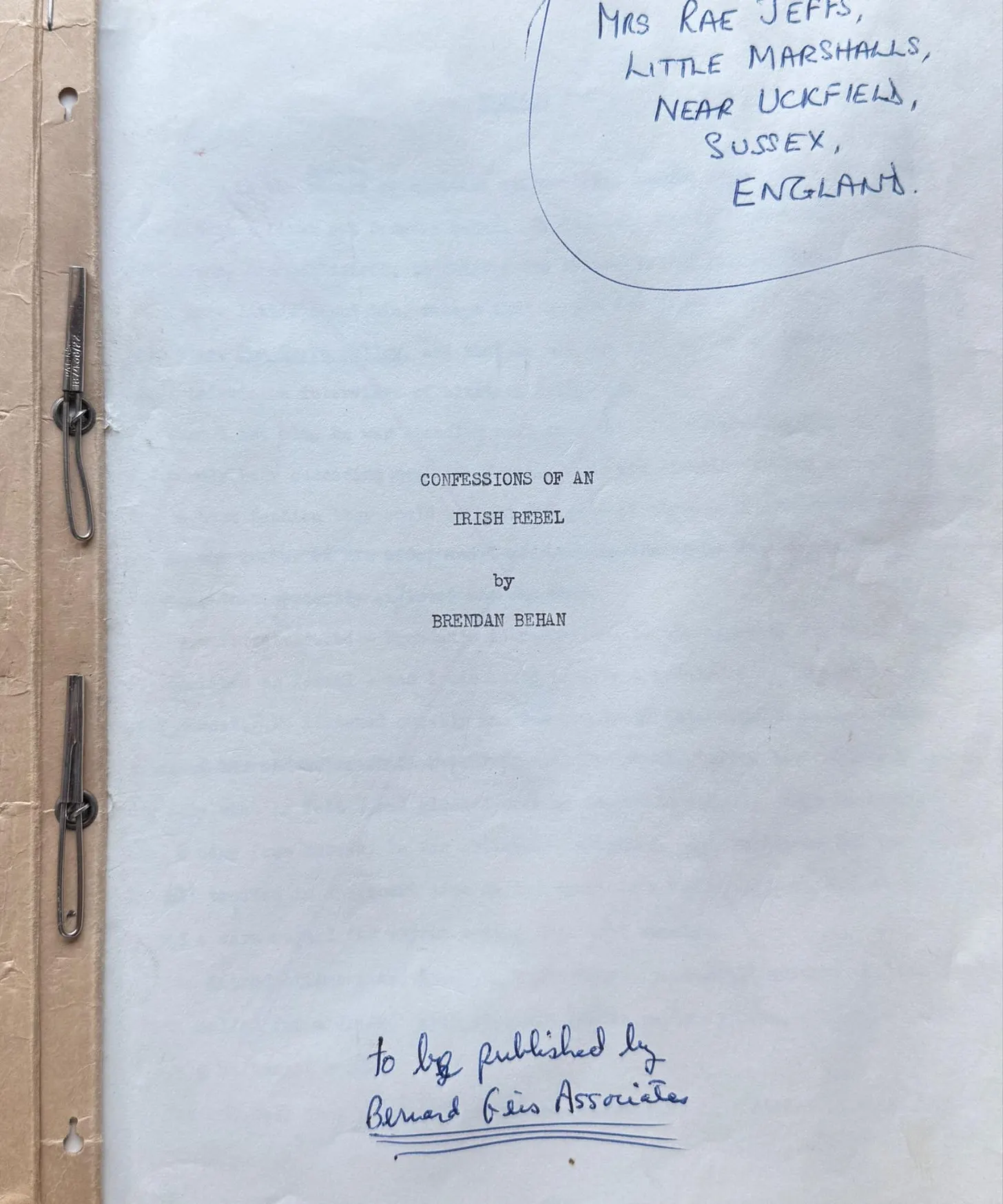
Behan drew extensively on his experiences in prison in his literary works, many of which appeared only after his death in 1964. Confessions of an Irish Rebel (1965), an autobiographical sequel to his earlier Borstal Boy (1958), is among these published posthumously. It is a “talk book,” dictated onto tape in 1963 when illness had rendered him unable to write. His editor Rae Jeffs, who had worked closely with Behan throughout his later career, transcribed and edited the tapes before preparing it for publication following his death. In the American Irish Historical Society’s collections, multiple editions of the manuscript survive alongside successive rounds of editorial shaping by Jeffs, and finally the version prepared for publication.
At every remove, something of Behan’s actual voice is necessarily lost or transformed; Jeffs’ posthumous edits shape Behan’s words into the form in which the world received them. Thus the book does not proceed directly and unmediated from Brendan Behan. It is, constitutively, a joint production, and the reader of the manuscript is watching a collaboration in progress, following the moment at which his voice and her editorial judgment meet and negotiate.
At the onset, Rae Jeffs provides an account of how Behan constructed himself before public appearances. He “would assume a completely different personality” since “he felt he had to live up to his reputation as the tough I.R.A. rebel, the man who would assault not only others, but himself as well, rather than conform.” The physical symptoms she catalogues, “beads of perspiration would break out on his forehead, and he would be cruel, abusive and arrogant,” register as signs of performance anxiety. Jeffs effectively introduces the dichotomous nature of Behan’s identity as an interpretive framework, foregrounding the structural gap between internal and external selfhood that his biography repeatedly instantiates.
As such, while confession as a form promises the dissolution of distance between performed and felt selfhood, Jeffs establishes, before the confession begins, that such dissolution was for Behan physiologically unavailable in public. The book is therefore structured around a paradox: it is a confession composed by a man who performed even his confessing. Rather than treating this as a failure of the form, it can be understood as the condition that gives the text its analytical interest and political force.
What follows takes this paradox as a point of departure, tracing a series of moments in Confessions of an Irish Rebel in which Behan’s confessional voice moves between private reflection and public performance, and reading these moments as sites where that division is most fully articulated.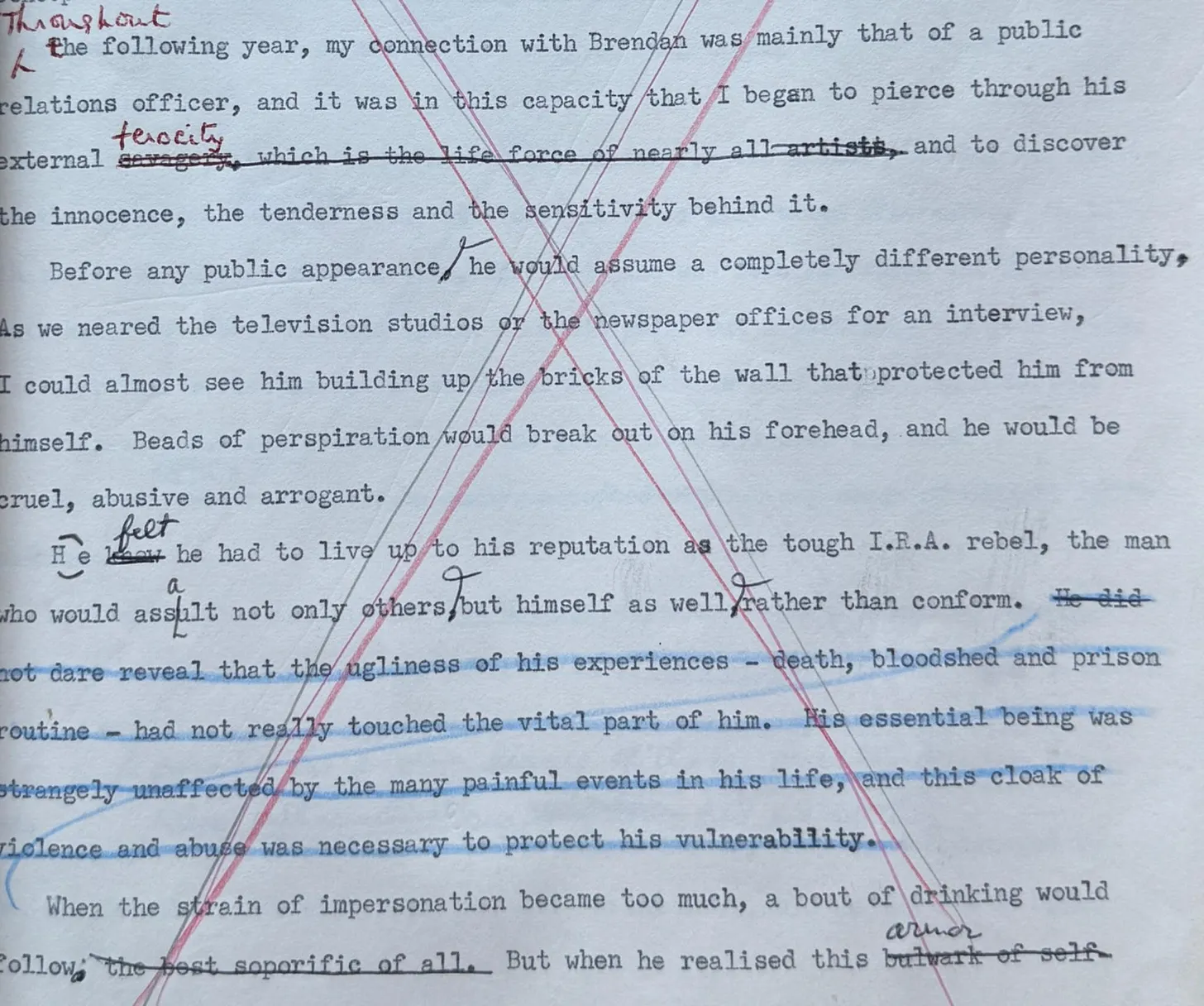
The courtroom scene offers a concentrated image of the structural gap between private voice and public performance. Behan explains that the statement he delivers to the court is recycled from a previous appearance, so its effect is already known to him. The passage opens, however, with something that cuts directly against that performance. “I reflected on the sadness of Irishman fighting Irishman or indeed I’m ashamed even to say now of men fighting men or men fighting women or women fighting women anywhere because I suppose at heart I’m a pacifist.” Within the same scene, Behan shouts “Up the Republic” across the courtroom. The private voice, reflective and admitting to pacifism and sadness, and the public voice, performative and defiant, do not cancel each other out or resolve into a synthesis. Behan understands the difference between what he feels and what he performs, and he chooses to perform nonetheless. The confession resides in the space between these two registers rather than in either one alone.
The following passage, a reflection on the Nuremberg trials, contains two distinct Behans: the one in the prison cell in 1946 and the one speaking into Rae Jeffs’ tape recorder in 1963. The confession takes place as the later Behan holds the earlier one to account, recalling a moment when he believed in capital punishment “even for a woman.” He admits that “I’m not very proud of these sentiments today.” The earlier self is preserved in the text without revision or erasure, while the later self stands beside it in dissent. This temporal doubling is made possible in a particular way by the mediated and collaborative nature of the text. The 1963 voice is recorded, transcribed, and edited by Jeffs, and then published after Behan’s death. By the time the reader encounters it, the dissenting present self has itself become historical. The confession thus becomes a dialogue across time, and that dialogue remains unresolved because both selves are preserved in the record, equally present and equally irreconcilable.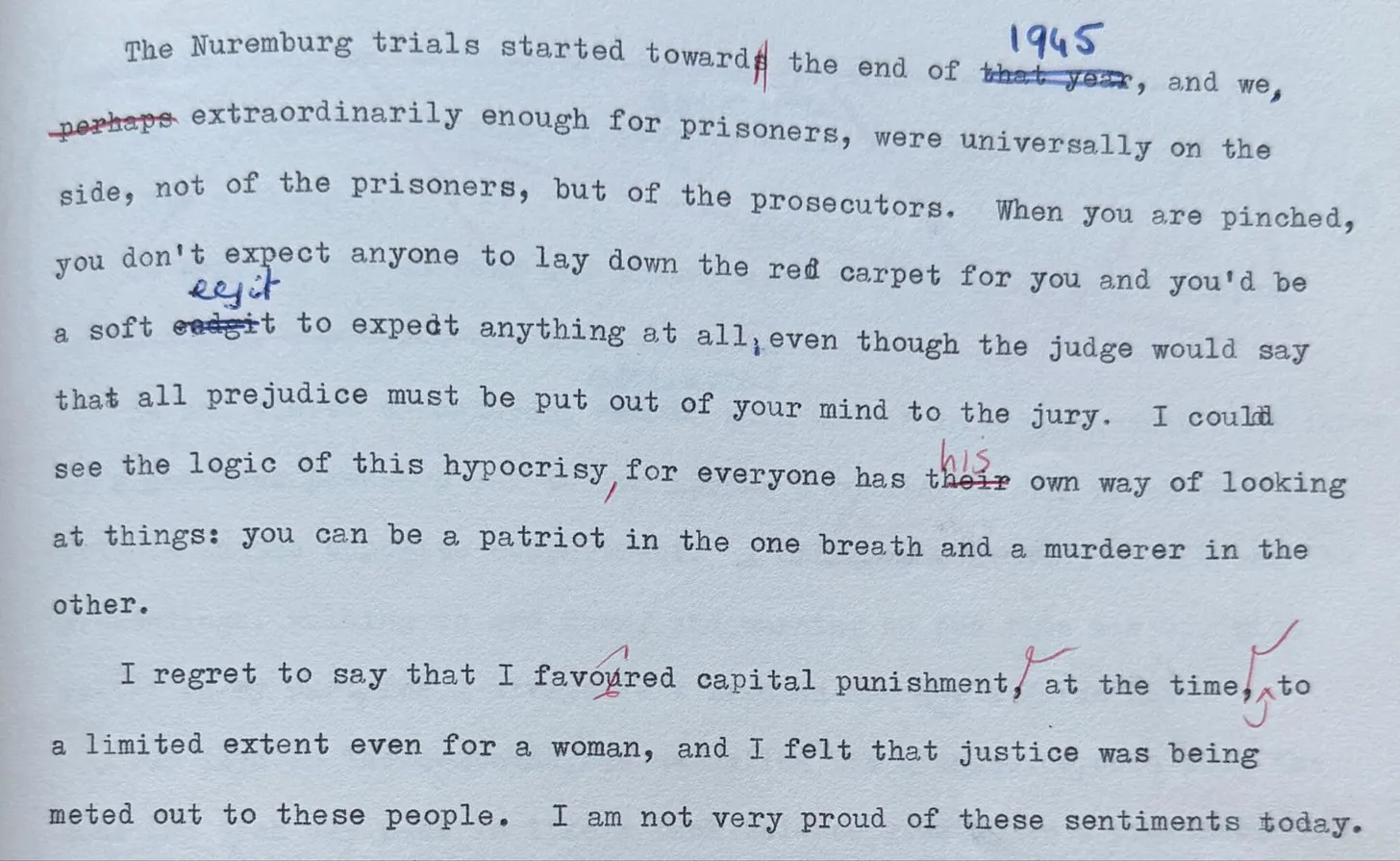
This final passage functions as a defense against a specific charge and as a retrospective theorization of the confessional project as a whole. Behan has been accused of ridiculing his faith and his fatherland. He contests the accusation regarding faith, but on the question of the fatherland he replies that “the first duty of a writer is to let his father land down, otherwise he is no writer.” He continues, “how the hell can a writer attack anyone else’s father land if he doesn’t attack his own?” In Behan’s articulation, the willingness to subject one’s own nation to critical scrutiny is a precondition of political credibility.
This claim gives the confessional mode of the book a retrospective coherence. Read in isolation, many of its moments of self-exposure might appear to be unguarded revelations produced under conditions in which Behan’s capacity for self-management had been diminished by illness. The closing passage reframes them, making each act of self-exposure an assertion of political integrity. The confession of Ireland’s contradictions and of Irish nationalism, given his own personal affiliation, is what authorizes Behan to speak beyond it. The same goes for himself; he critiques himself in order to speak beyond himself.
The mediated and collaborative nature of the text, established through the archival conditions of its production, reinforces this interpretation. A work dictated onto tape, transcribed and edited by another hand, and published posthumously cannot claim the kind of sovereign authorial coherence that might sustain a more conventional confessional narrative. Instead, Confessions of an Irish Rebel is a self-aware performance of the impossibility of unperformed selfhood, and Behan turns that impossibility into a sustained argument about the conditions of political voice.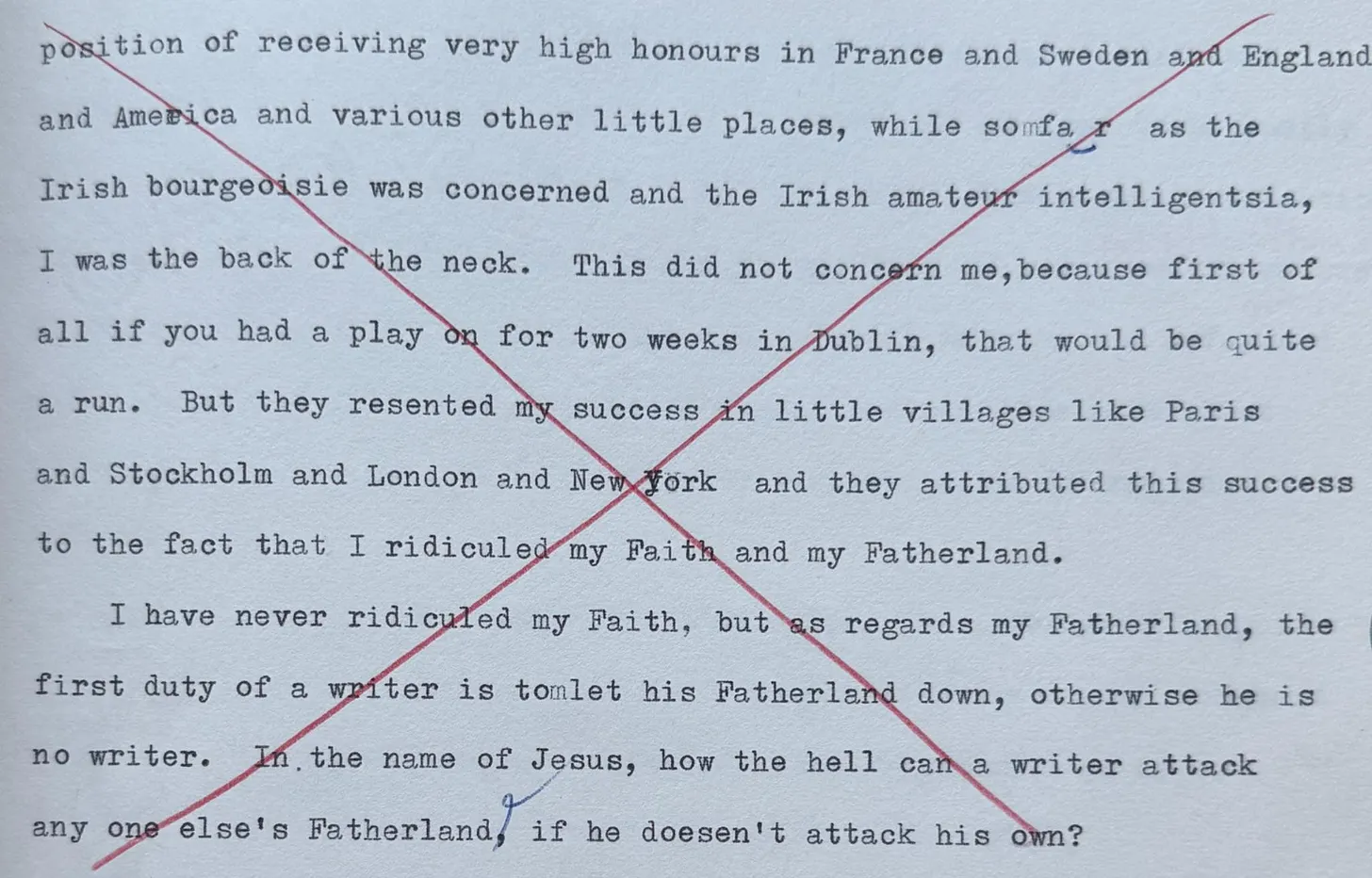
Author Bio:
Ella Rose is an archives intern at the American Irish Historical Society and an Honors History and Politics student at NYU. Her research focuses on Irish political identity, diaspora communities, and state formation.